The Perception Gap: Why Motorways Feel More Dangerous
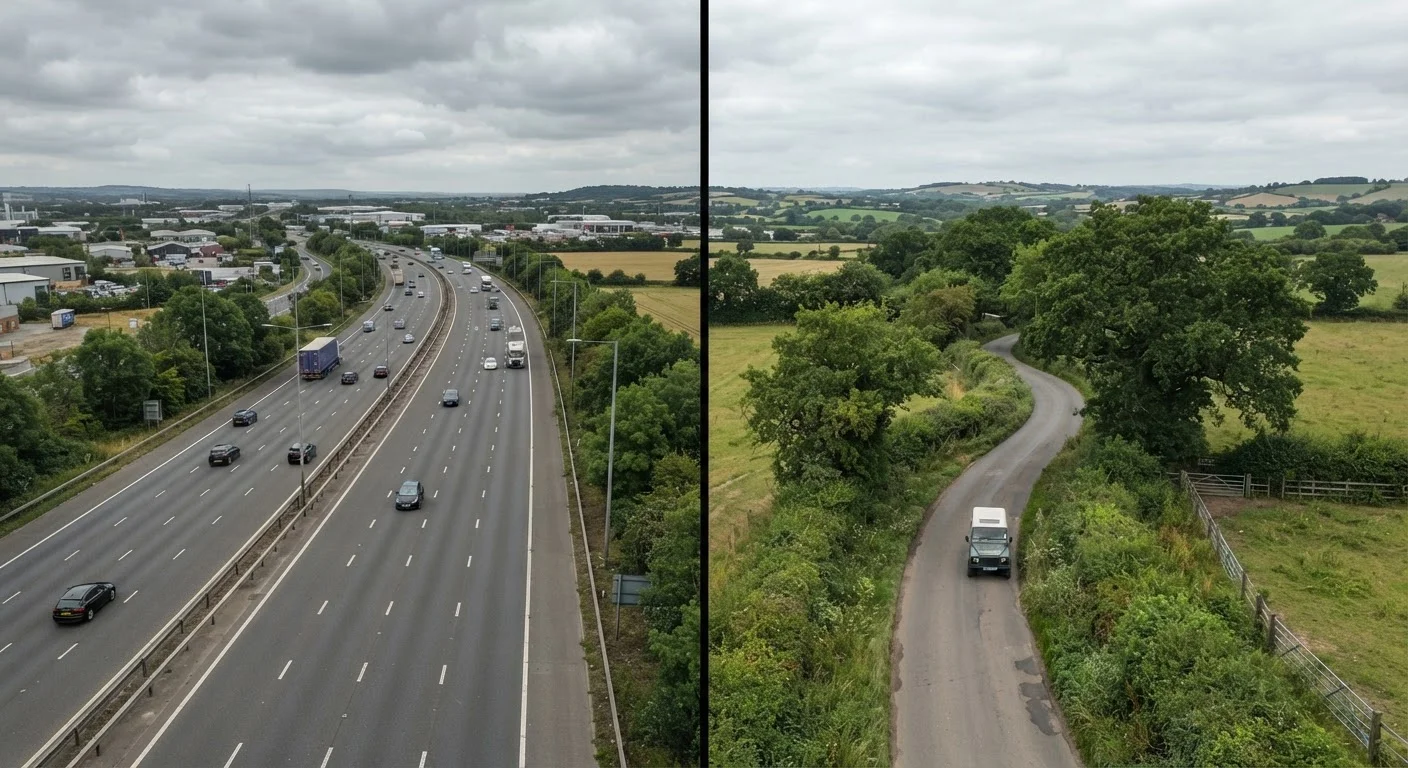
Speed creates fear. When you're traveling at 70 mph surrounded by other vehicles, the stakes feel viscerally high. This is a reasonable instinct - but it can create a blind spot. Motorways (known as interstates or freeways in the US) are among the most heavily engineered road types in existence, with divided lanes, banked curves, controlled access points, and consistent signage. All of that infrastructure is specifically designed to reduce collision risk.
By contrast, rural roads feel manageable. The posted limit might be 55 mph, traffic is sparse, and there are no merging semis bearing down on you. That sense of control can encourage exactly the kind of inattention that causes crashes. Distraction takes many forms, and a quiet country road is where complacency most often sets in.
| Motorway / Interstate | Rural Road | |
|---|---|---|
| Fatality rate per mile | Lower | Higher (2-3x by some measures) |
| Primary crash types | Rear-end, lane-change | Head-on, run-off-road |
| Traffic separation | Physical median barrier | Painted centerline only |
| Emergency response time | Generally faster | Often significantly delayed |
| Driver fatigue risk | High (monotonous) | Moderate (more variation) |
| Unpredictable hazards | Lower (controlled access) | Higher (junctions, wildlife, surface) |
| Complacency risk | Moderate | High |
What the Data Actually Shows
According to the National Highway Traffic Safety Administration (NHTSA), rural roads consistently account for roughly half of all US traffic fatalities despite carrying a significantly smaller share of total vehicle miles traveled. The fatality rate per mile on rural roads has historically been two to three times higher than on urban roads or interstates.
The reasons are structural. Rural roads are more likely to have no shoulders, steep drop-offs, unmarked intersections, and limited lighting. Emergency response times are longer, meaning that when a serious collision does occur, the window for life-saving intervention is narrower. Head-on collisions - among the most lethal crash types - are far more common on two-lane rural roads where there is no physical barrier between opposing lanes of traffic.
~50%
Rural share of US traffic fatalities
NHTSA data consistently shows rural roads account for approximately half of all US traffic deaths despite lower traffic volumes.
2-3x
Higher rural fatality rate per mile
The fatality rate per vehicle mile traveled on rural roads has historically been two to three times that of urban roads and interstates.
~40%
Rural fatal crashes involving departure from roadway
Run-off-road crashes - often caused by excessive speed on curves - are among the most common fatal crash types on rural roads nationally.
Motorway fatalities, while serious and highly visible, occur at a lower rate relative to miles driven. The physical separation of opposing traffic alone eliminates an entire category of high-severity crashes. For a deeper look at how speed limits interact with actual safety, see our piece on speed limits, road conditions, and safe speed.
The Specific Hazards of Each Environment
Motorways
- Merging and lane changes: Most motorway crashes involve vehicles changing lanes or entering/exiting at speed. Blind spots are a persistent hazard, particularly around large trucks.
- Fatigue: Long, monotonous stretches promote drowsiness. Cruise control and a lack of visual variety reduce the stimulation that keeps drivers alert.
- High closing speeds: When traffic slows suddenly, vehicles traveling at highway speed have much less stopping distance than many drivers allow for.
Rural Roads
- Unmarked hazards: Gravel patches, potholes, and eroded edges can appear without warning, especially on infrequently maintained roads.
- Wildlife and farm vehicles: Animals crossing and slow-moving agricultural equipment create sudden, unpredictable obstacles.
- Hidden junctions and bends: Sight lines are often limited by hedgerows, hills, or vegetation - meaning a junction can appear with almost no warning time.
- Overconfidence at lower speeds: A 55 mph head-on collision is still potentially fatal. The absence of obvious danger signals does not equal the absence of danger.
Weather adds a layer of complexity to both environments. See our guide on driving in rain, fog, and snow for techniques specific to deteriorating conditions.
Driving Habits That Reduce Risk on Both Road Types
The good news is that the same foundational habits protect you regardless of which road type you're on. Appropriate following distance - generally a minimum of three seconds in good conditions - gives you reaction time on a rural bend just as much as in motorway traffic. Getting the basics right before you set off, including mirror alignment and seat positioning, pays dividends on every journey.
On motorways specifically, lane discipline matters both legally and practically. Staying in the right lane except when overtaking reduces conflict points and predictable merging situations. On rural roads, the discipline is different: slow down before blind bends (not during them), position your vehicle to maximise your sight line around curves, and be prepared for oncoming traffic to be wider than expected - a tractor or van can occupy a significant portion of a narrow lane.
Modern vehicle safety technology helps on both environments. Active systems like automatic emergency braking and lane-keeping assist are most effective when drivers understand their limitations - they supplement attention, not replace it. Our comparison of active and passive safety systems explains what these features can and cannot do.
If you're a newer driver, rural roads deserve particular respect. New drivers frequently misjudge rural hazards because test routes rarely include the full range of challenges these roads present at speed.