What the Posted Limit Actually Means
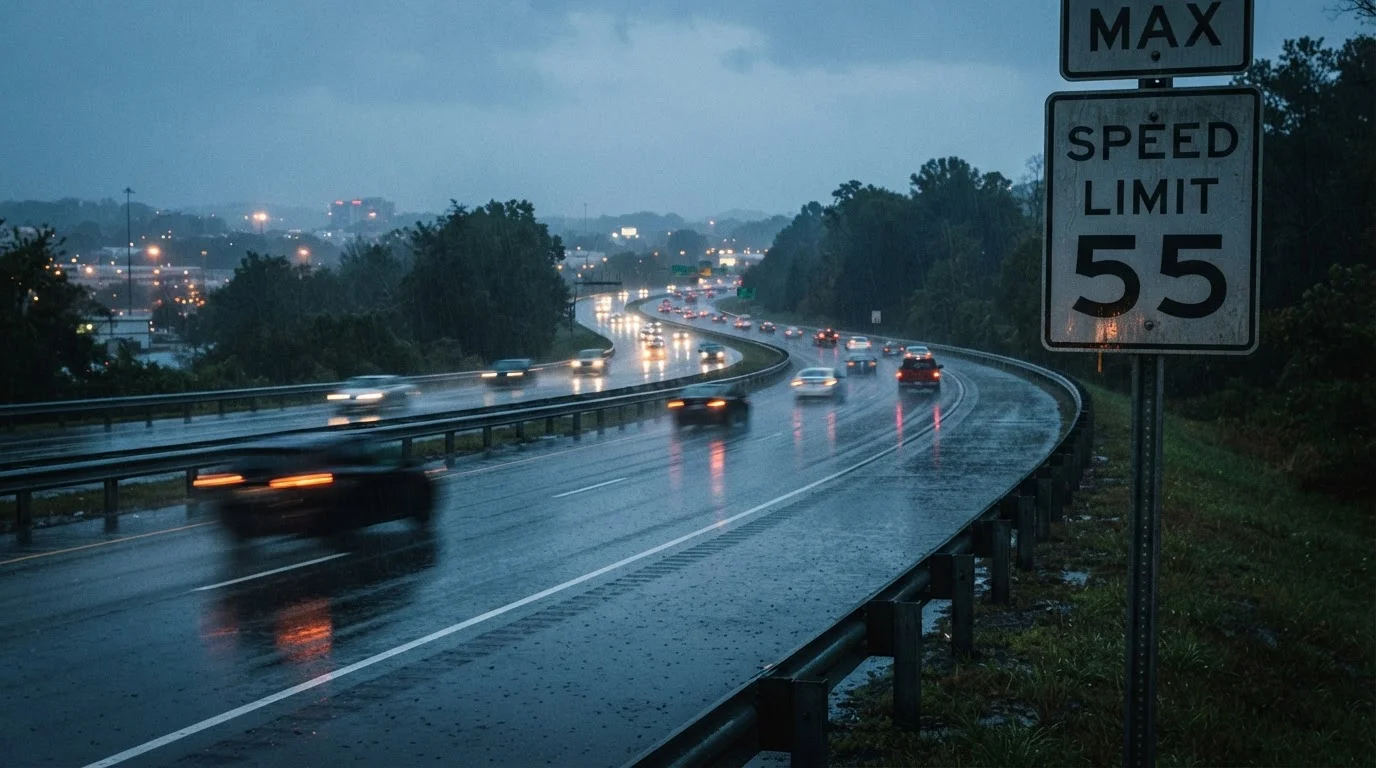
Speed limit signs communicate the maximum lawful speed under normal, favorable conditions. Traffic engineers set them based on road design, lane width, sight lines, and typical traffic patterns - not on fog, black ice, or a vehicle three car lengths ahead braking hard. When conditions change, the legal cap does not automatically adjust, but your responsibility to drive safely does.
Most U.S. states encode this duty in what is called the basic speed rule: a driver must travel at a speed that is reasonable and prudent given actual conditions. That means a 65 mph interstate limit does not authorize 65 mph in a whiteout blizzard. Officers can issue citations for unsafe speed even when a driver is under the posted number - and courts routinely uphold them.
See our guide to road signs you may have forgotten for a broader refresher on how regulatory signs work and what they legally require of you.
How Road Conditions Change the Equation
Traction, visibility, and road geometry are the three variables that most directly set a practical speed ceiling - independent of the posted number.
Traction
On dry asphalt, modern tires grip the road well enough that posted highway speeds are generally manageable. Add water and that grip drops noticeably; add ice and it can fall by more than half. Stopping distance - the total distance from the moment you perceive a hazard to the moment the vehicle halts - grows with every reduction in traction. At 60 mph on dry pavement, a typical passenger car needs roughly 270 feet to stop. On wet pavement, that figure climbs; on ice, it can exceed 700 feet under the same initial conditions.
Visibility
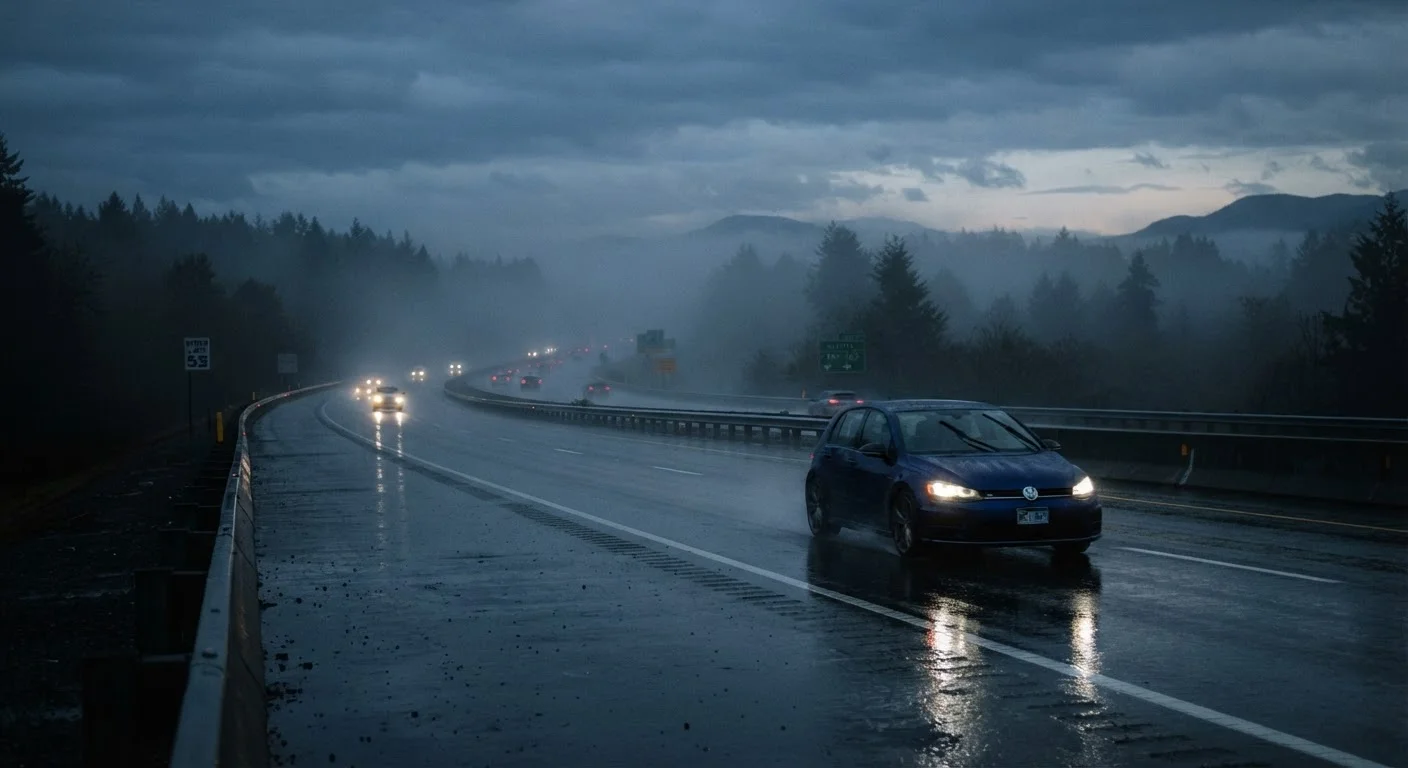
A core principle of safe speed is that you must be able to stop within the distance you can see ahead. If heavy fog limits your sight line to 200 feet, traveling at a speed that requires 300 feet to stop is not a matter of preference - it is a collision waiting to happen. The same logic applies to unlit rural roads at night and to cresting hills where the road ahead is hidden. Our article on driving in rain, fog, and snow covers specific techniques for each of these scenarios.
Road Geometry
Curves and steep grades change the physics of vehicle control. Taking a sharp bend at a speed that feels comfortable on a straight road can push a vehicle beyond the limits of its suspension and tire grip. Speed limit signs posted before curves are often advisory - a yellow sign with a recommended speed - not a legal maximum, but they reflect engineering calculations about where vehicle dynamics begin to work against you.
~50%
Increase in stopping distance on wet pavement
Traffic safety research consistently estimates that wet road surfaces extend braking distances by approximately 50% compared to dry conditions at equivalent speeds.
4×
Stopping distance increase when speed doubles
Because kinetic energy scales with the square of velocity, doubling speed requires roughly four times the stopping distance, a relationship well established in basic physics and highway safety engineering.
~56%
Share of U.S. traffic fatalities on rural roads
The National Highway Traffic Safety Administration (NHTSA) has consistently reported that rural roads account for a disproportionate share of fatal crashes relative to their traffic volume.
Speed, Stopping Distance, and the Margin for Error
One of the most underappreciated facts in driver education is that stopping distance does not scale linearly with speed - it scales with the square of speed. Double your speed and you need roughly four times the distance to stop, not twice. This means the gap between a near-miss and a collision narrows very quickly as speed rises above what conditions support.
Following distance is directly tied to this. The faster you travel, the more space you need ahead to react and brake. Our article on following-distance rules and their limits explains how the commonly cited two-second rule can be insufficient in adverse conditions and at higher speeds.
Recalibrate Before You Enter Adverse Conditions
Do not wait until you are already in fog, rain, or a construction zone to reduce speed - by then your reaction time is already compressed. Ease off the accelerator as soon as you see conditions changing ahead. This gives you time and distance to adapt rather than forcing a reactive, emergency response.
It is also worth noting that driving significantly below the flow of traffic on a high-speed road creates its own hazards. Safe speed is not simply the lowest possible number - it involves reading the full environment, including what other vehicles around you are doing.
Practical Habits for Matching Speed to Conditions
Adjusting speed intelligently is a skill, not just an instinct. A few consistent habits help drivers stay within genuinely safe margins:
- Reduce speed proactively, not reactively. Slow down before you enter fog, a curve, or construction - not after conditions have already compromised your control.
- Use environmental cues. Spray from other vehicles, black ice warnings, and reduced lane markings are signals to drop speed immediately.
- Recalibrate your following distance. In rain or low visibility, the standard guidance on gap distance understates what you actually need. Increase it substantially.
- Avoid relying on driver aids as a substitute for speed judgment. Anti-lock brakes and stability control reduce the risk of losing control, but they do not override physics - a vehicle traveling too fast for conditions will still exceed its stopping ability.
Rural roads deserve particular attention. As detailed in our piece on rural road risk versus motorway risk, these routes account for a disproportionate share of serious collisions despite often having lower posted limits, precisely because their geometry and surface variation demand more of the driver.