Why the Two-Second Rule Has Become Shorthand - And Where It Falls Short
The two-second following distance rule has been a staple of driver education for decades, and for good reason: it's simple, memorable, and easy to apply at a glance. Pick a stationary object - a sign, a bridge - and count the seconds between when the car ahead passes it and when you do. If you reach two, you have a workable baseline gap.
The problem is that many drivers treat the rule as a hard ceiling rather than a soft floor. Road conditions, speed, vehicle load, and visibility can each independently expand the distance you actually need to stop safely. A rule designed for dry pavement at moderate speeds cannot cover every scenario a real driver encounters.
Myth
Two seconds of following distance is always enough to stop safely.
Fact
Two seconds is a widely used minimum for ideal conditions, but it falls short at highway speeds, in poor weather, or when driving a heavily loaded vehicle.
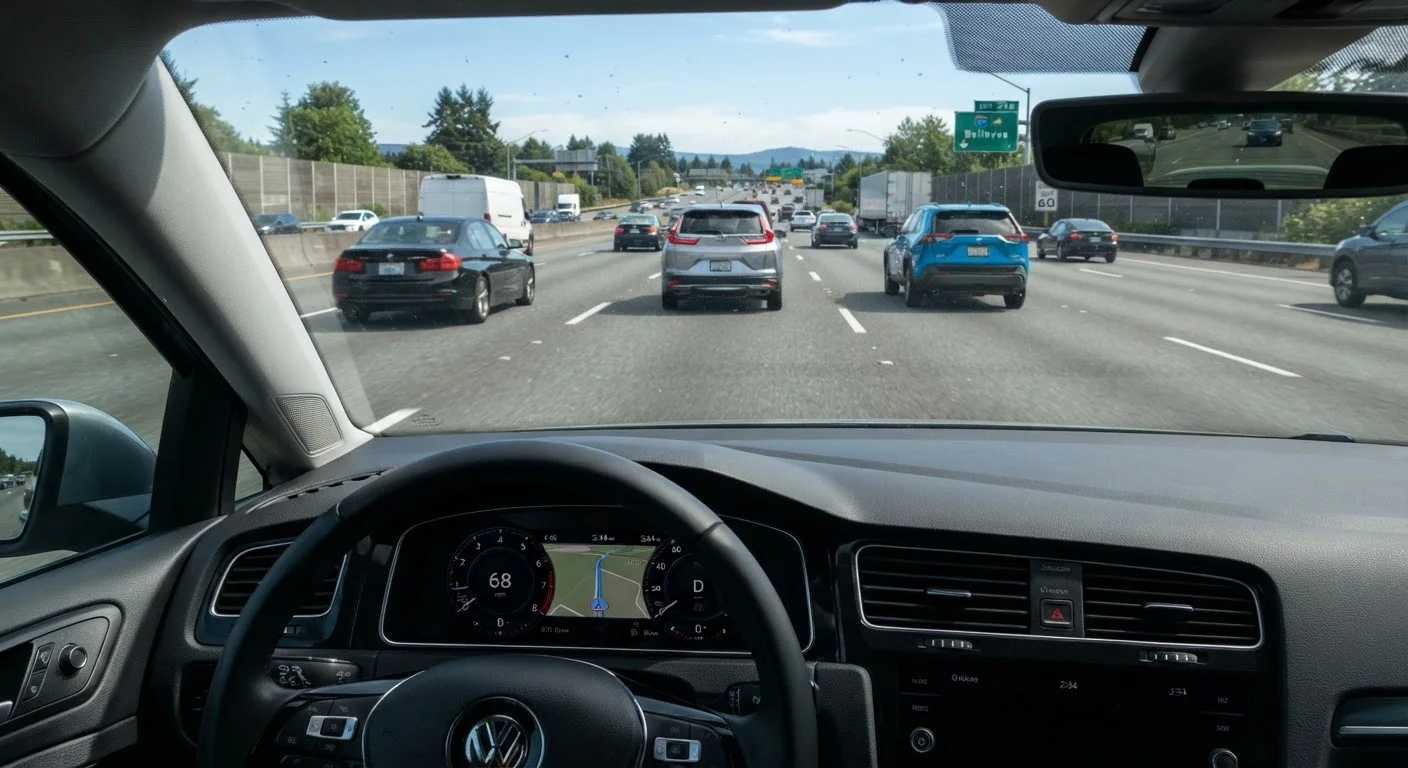
The two-second rule - choosing a fixed point ahead and ensuring at least two seconds pass before you reach it - is a practical starting benchmark taught in driver education. However, it was designed for dry pavement at moderate speeds. At 70 mph, two seconds translates to roughly 205 feet of following distance. While that sounds substantial, it may not fully account for perception time (the moment you register a hazard), reaction time (the moment your foot reaches the brake), and the vehicle's actual braking distance. Federal safety research and traffic engineering literature consistently treat two seconds as a floor, not a ceiling.
Myth
The same following distance works at any speed.
Fact
Stopping distance increases disproportionately - not linearly - as speed rises, meaning faster driving demands a much larger gap.
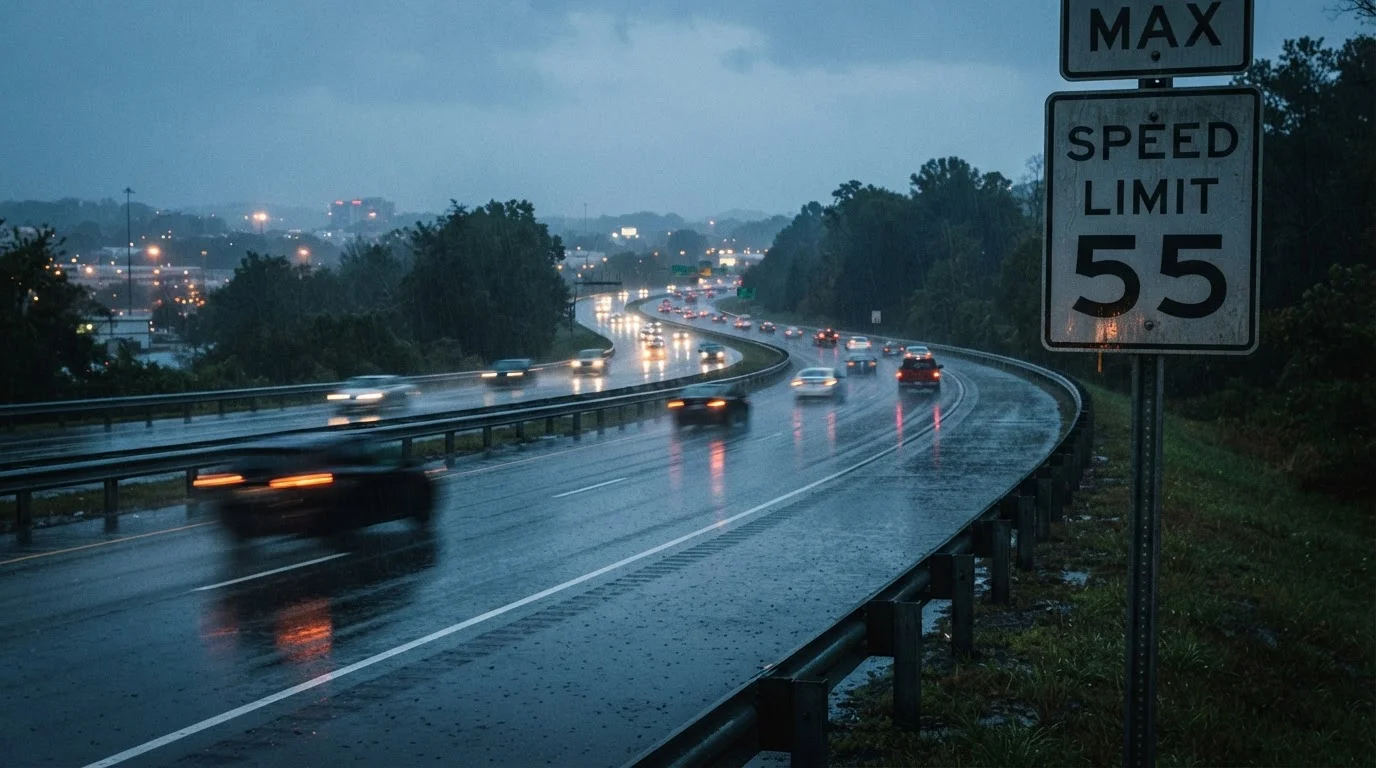
Physics is the issue here. Kinetic energy - the energy your vehicle must shed during braking - grows with the square of your speed. Doubling your speed from 30 to 60 mph doesn't double your stopping distance; it roughly quadruples it. This is why traffic safety professionals often recommend three or more seconds on highways and expressways. As our coverage of speed and road conditions explains, posted limits represent legal maximums, not automatic guarantees of safety.
Myth
If you have good brakes or a newer car, you can follow more closely.
Fact
Modern braking technology improves stopping performance, but reaction time - the human element - remains unchanged and accounts for a significant portion of total stopping distance.
Anti-lock braking systems (ABS) and automatic emergency braking (AEB) are genuine safety advances. ABS prevents wheel lockup so you maintain steering control during hard stops; AEB can apply brakes faster than most drivers react. But these systems operate after a hazard is detected. The roughly 1.5-second average human perception-reaction time still adds 66-100 feet of travel at highway speeds before any braking begins. Vehicle condition, tire tread depth, and load weight further affect how quickly the car actually stops once braking starts. Technology narrows the margin for error - it doesn't eliminate it.
Myth
Leaving a large gap just invites other drivers to cut in front of you.
Fact
Even when another vehicle merges into your gap, the practical safety benefit of maintaining space remains - you simply re-establish the distance.
This is one of the most commonly cited reasons drivers give for following closely in heavy traffic. While it's true that a visible gap may attract lane changes, the correct response is to ease off the accelerator slightly and restore your following distance - not to close the gap aggressively. Tailgating in anticipation of being cut off creates a more dangerous situation than the merge itself. Staying composed and rebuilding your cushion is both safer and, according to traffic flow research, actually helps reduce the stop-and-go wave patterns that slow highways down for everyone.
Myth
Adaptive cruise control manages following distance so you don't have to think about it.
Fact
Adaptive cruise control (ACC) maintains a set gap in steady traffic but has known limitations in cut-in scenarios, poor weather, and stop-and-go conditions that require driver attentiveness.
ACC systems use radar or cameras to maintain a driver-selected following gap from the vehicle ahead. They work well in stable, predictable highway conditions. However, most systems have a response lag when a vehicle cuts sharply into your lane, reduced sensor reliability in heavy rain or snow, and varying performance at very low speeds. Manufacturers and the National Highway Traffic Safety Administration (NHTSA) are explicit that ACC is a driver-assistance feature - not a substitute for an engaged driver. Keep your hands on the wheel and your attention on the road even when ACC is active.
The Science Behind Stopping Distance
Every stop involves two distinct phases. First, there's the perception-reaction phase - the time from when your eyes register a hazard to when your foot makes contact with the brake pedal. This averages around 1.5 seconds for most drivers under normal alertness. During that time, your vehicle is still traveling at full speed.
Second, there's the braking phase - the time and distance required for your car to actually decelerate to a stop. This phase is governed by speed, road surface friction, tire condition, vehicle weight, and braking system capability. Together, these two phases determine your true stopping distance - which is nearly always longer than drivers intuitively assume.
~29%
Of all U.S. crashes are rear-end collisions
According to NHTSA research, rear-end crashes are one of the most frequent crash types on American roads, with following distance and inattention as primary factors.
1.5 sec
Average driver perception-reaction time
Traffic engineering references commonly cite approximately 1.5 seconds as the average time from perceiving a hazard to beginning to brake, a figure that doesn't improve with a newer vehicle.
2×-4×
Stopping distance increase on wet or icy roads
Transport safety organizations note that wet pavement can roughly double stopping distances, while ice and snow can increase them several times compared to dry conditions.
Understanding this two-phase reality helps explain why adjustments for conditions matter so much. Fatigue, distraction, or impairment can extend the perception-reaction phase well beyond 1.5 seconds - another reason a larger buffer is nearly always the safer choice.
When Standard Advice Needs Adjusting
Experienced drivers know that following distance isn't a fixed number - it's a dynamic calculation. Several factors commonly push the required gap well beyond two seconds:
- Highway speeds: At 65-75 mph, most safety professionals recommend three or more seconds as a baseline.
- Adverse weather: Wet, icy, or snow-covered roads dramatically reduce tire grip and extend braking distances.
Adverse Conditions Demand Much More Space
On wet pavement, stopping distances can roughly double compared to dry roads. On ice or snow, they can increase several times over. The two-second rule was developed with dry-road conditions in mind. If you're driving in rain, fog, snow, or at night, traffic safety experts broadly recommend increasing your following gap to at least three to four seconds - or more. See also our guide on night driving habits for related visibility guidance.
- Towing or hauling: A loaded truck or vehicle towing a trailer has significantly more momentum and typically longer stopping distances.
- Night driving: Reduced visibility compresses your ability to detect and respond to hazards ahead. Our night driving habits guide covers this dimension in depth.
- Following large vehicles: Trucks and buses block forward sightlines, making it harder to see hazards further ahead and requiring additional gap to compensate.
None of these adjustments require complex mental math. They simply call for a habit of asking: Do conditions warrant more space than my default? In most real-world driving, the honest answer is yes.
Following Distance Is a Life-Safety Issue
Rear-end collisions are among the most common crash types on U.S. roads, and insufficient following distance is a primary contributing factor. No rule of thumb overrides the need to adjust your gap based on your actual speed, road surface, and visibility. When in doubt, increase your distance - there is no downside to giving yourself more time to react.