Why Carry-On Only Is Worth the Discipline
Checking a bag on a two-week trip costs money, time, and flexibility. Checked-bag fees vary by airline but routinely add $30–$70 per leg, and that's assuming your bag arrives. Traveling carry-on only eliminates those fees, removes the risk of lost luggage, and lets you move through airports faster — a real advantage when you're catching tight connections or hopping between cities.
The mental shift required is straightforward: you're not packing for the worst-case scenario. You're packing for the most likely one. Most destinations have pharmacies, laundromats, and shops. Anything you forget can generally be bought. That reframe alone removes a lot of unnecessary weight from your bag.
For broader context on how packing light fits into a cost-conscious travel plan, see our end-to-end budget travel framework.
What you will need
Choosing the Right Bag
Before you pack a single item, confirm your bag actually qualifies as a carry-on for every airline you're flying. Domestic U.S. carriers typically allow bags up to 22 x 14 x 9 inches, but international or budget carriers — including low-cost European and Asian airlines — often impose stricter limits, both on dimensions and weight. Check the specific policy for each carrier on your itinerary.
A bag in the 40–45 liter range is generally sufficient for two weeks if you pack efficiently. Hard-shell spinners look sleek but tend to waste edge space; a structured soft-side bag with external compression straps gives you more packing flexibility. A daypack or personal item that fits under the seat is a valuable second layer — it's where your tech, documents, and in-flight essentials live, keeping the overhead bin bag truly optimized for clothes.
Carry-on bag (40–45 liters)
Primary bag for clothing and non-electronic gear; must meet airline size requirements.
Packing cubes or compression cubes
Organize and compress clothing into discrete, easy-to-access sections inside the bag.
Personal item / daypack
Holds tech, documents, snacks, and in-flight essentials while keeping the main bag optimized.
Luggage scale
Confirms your packed bag meets any airline weight limits before you reach the gate.
Travel-size toiletry bottles
Allows you to carry liquids within TSA 3-1-1 rules without bringing full-size products.
Universal travel adapter
Enables charging in countries with different outlet standards without carrying multiple adapters.
Building Your Packing List
The clothing list is where most people go wrong. A two-week trip does not require 14 outfits. It requires a small set of pieces that work together and can be washed mid-trip. A practical starting point for a temperate destination:
- Bottoms: 2–3 pairs (one casual, one versatile enough for a nicer dinner, one active)
- Tops: 4–5 (mix of short and long sleeve depending on climate)
- Underwear and socks: 5–7 pairs in merino wool or moisture-wicking fabric
- Shoes: 2 pairs maximum — one walking shoe that can dress up, one casual or sport option
- Outerwear: one packable layer appropriate to the destination
Quick-dry and merino wool fabrics are worth prioritizing. They resist odor, dry overnight after a sink wash, and pack smaller than cotton. That means you can re-wear items comfortably and do a quick laundry session mid-trip rather than hauling two weeks' worth of clothes.
Toiletries deserve their own discipline. Bring only what you'll genuinely use, in travel-size quantities, and accept that shampoo, sunscreen, and most personal care products are available to buy abroad. If your trip takes you somewhere with limited access to goods, plan accordingly — but that's the exception, not the rule.
For a broader departure-day checklist that includes documents, health prep, and booking confirmations, our pre-trip checklist covers the full picture. And if managing costs before you leave is a concern, the pre-departure cost checklist can help you avoid avoidable fees.
Plan Around One Mid-Trip Laundry Day
A single laundry stop — at a laundromat, hotel guest laundry, or via sink washing overnight — effectively doubles your wardrobe without adding a single item to your bag. Plan for it on day 7 or 8 and you'll never feel like you're running short on clean clothes. Quick-dry and merino wool fabrics make this routine rather than a chore.
How to Pack the Bag Efficiently
Method matters. Rolling clothes — especially soft items like t-shirts and underwear — creates compact cylinders that fill a bag's contours more efficiently than flat folding. Packing cubes add structure and make it easier to find things mid-trip without unpacking everything. Compression cubes offer an extra reduction in volume for bulkier items like fleece layers.
Put heavy items (shoes, toiletry bag) near the wheels or the back panel, closest to your body when the bag is upright. This keeps weight low and balanced. Fill dead space: socks inside shoes, chargers inside hats. Light, compressible items like a packable jacket go on top or in any remaining gaps.
Before your first real pack, do a trial run at home — fully packed, weighed if your airline has a carry-on weight limit, and tested for maneuverability. Identify anything that doesn't pull its weight and leave it behind.
Verify your bag's dimensions against every airline on your itinerary
Look up the carry-on size and weight policy for each carrier you're flying — including any budget airlines on connecting legs. Do this before purchasing or committing to a bag. Policies differ, and an oversized bag may be gate-checked at your expense.
Write a packing list before touching your bag
Start with a written list organized by category: clothing, toiletries, tech, documents, and miscellaneous. Assign a rough quantity to each category based on trip length, activities planned, and access to laundry. Review the list critically and cut anything without a clear daily use case.
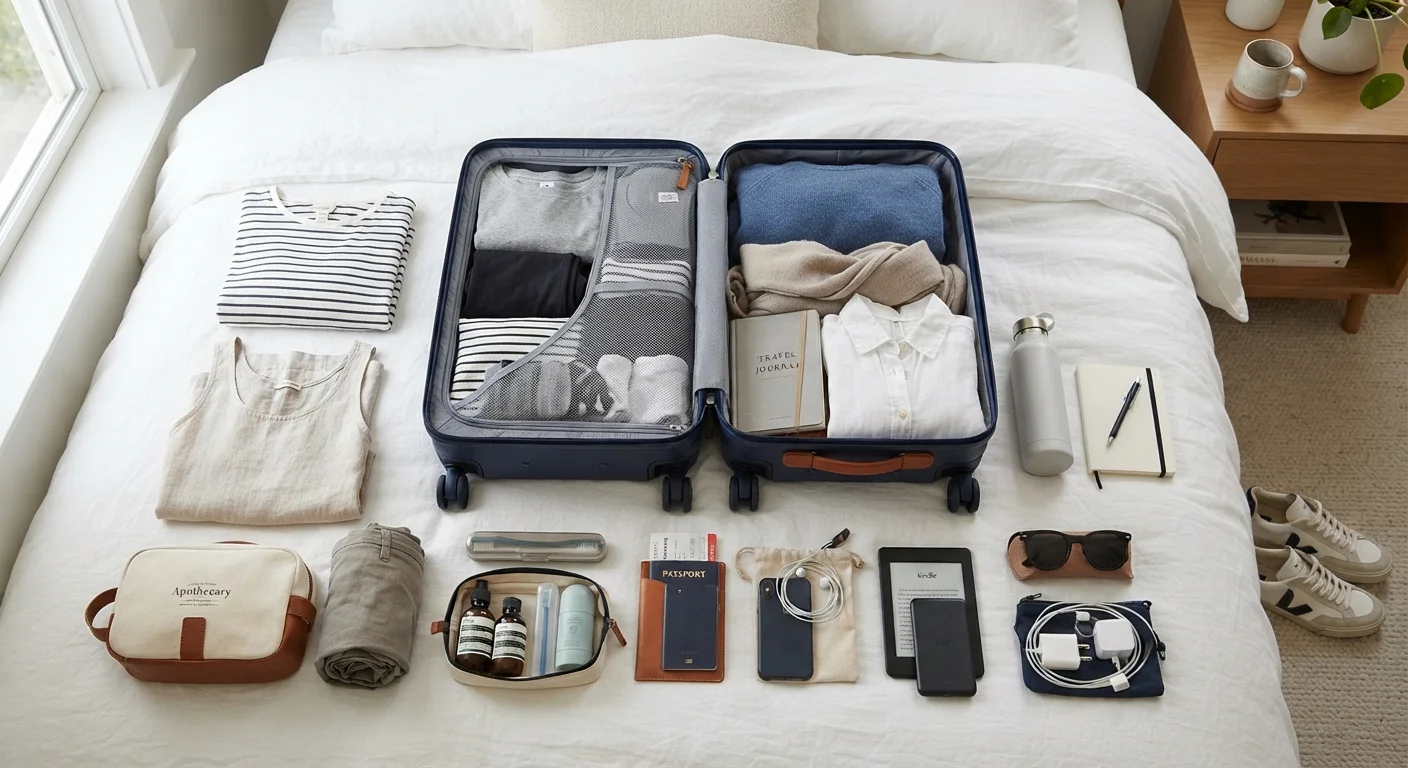
Lay everything out and cut 20–30% before packing
Place every item you intend to bring on a flat surface. Look at the pile honestly. Most travelers find at least one-quarter of their initial selection is redundant, too bulky, or genuinely unnecessary. Remove those items now rather than discovering it when the bag won't close.
Pack using rolls and cubes for maximum compression
Roll soft clothing items into tight cylinders. Use packing cubes to group categories (tops, bottoms, underwear) and compress the contents. Place heavy items against the back panel, lighter and compressible items on top. Fill all dead space — shoes, gaps along edges, inside hats.
Do a full trial pack at home before departure day
Pack the bag completely as if you're leaving tomorrow. Weigh it if your airline imposes a carry-on weight limit. Try lifting it into an overhead bin height (about 6 feet) and carrying it for a few minutes. If it's too heavy or awkward, remove items until it's manageable for a full day of travel.
What Most People Overpack (and Can Leave Behind)
Travel experience consistently points to the same categories of excess. Books and paper — most trips are better served by an e-reader or phone-based reading app. Multiple pairs of shoes beyond two — they're the heaviest, bulkiest items in any bag. "Just in case" clothing for scenarios that rarely materialize, like a formal event you're not actually attending. Full-size toiletry bottles when travel-size or local alternatives work just as well.
Electronics are another common source of bloat. Bring only what you'll realistically use daily. A single universal travel adapter, one pair of earbuds, and a compact power bank cover most travelers' needs. Laptop vs. tablet is a genuine trade-off worth evaluating based on your specific work and entertainment needs.
The honest test: if you're unsure whether to bring something, leave it. If you genuinely need it, you'll know exactly why before it goes in the bag. That clarity is the habit that separates experienced light packers from everyone else.