
Why Experienced Drivers Misread Signs
Passing your driving test requires you to know road signs cold. But once you're driving daily, signs shift from conscious cues to background noise. Research in traffic psychology suggests that perceptual automaticity - the brain processing familiar stimuli without full attention - can cause experienced drivers to glance at a sign, register its color or shape, and move on without reading its specific instruction.
The result: many drivers hold confident but inaccurate mental models of signs they encounter regularly. This refresher covers the categories most likely to be misremembered, misapplied, or confused with one another.
Regulatory Signs: Rules, Not Suggestions
Regulatory signs carry legal weight. Failing to obey them is a traffic violation. Yet several are routinely misunderstood:
- Stop vs. Yield: A Stop sign (red octagon) requires a complete stop before the limit line, regardless of whether traffic is present. A Yield sign (red-bordered downward triangle) requires you to slow and give right-of-way to conflicting traffic - a full stop is only required if traffic makes it necessary. Many drivers treat Yield as an advisory slowdown rather than a true right-of-way obligation. For a deeper look at how right-of-way rules play out in practice, see our guide on how roundabouts work.
- Do Not Pass vs. No Passing Zone markings: The Do Not Pass pennant sign (horizontal, yellow, pointing right) supplements pavement markings but does not replace them. Drivers who rely solely on road markings can miss the sign on roads with worn lane striping.
- One Way signs: These apply in the direction shown - not to the road as a whole. A one-way designation on a side street can catch drivers off-guard at unmarked intersections.
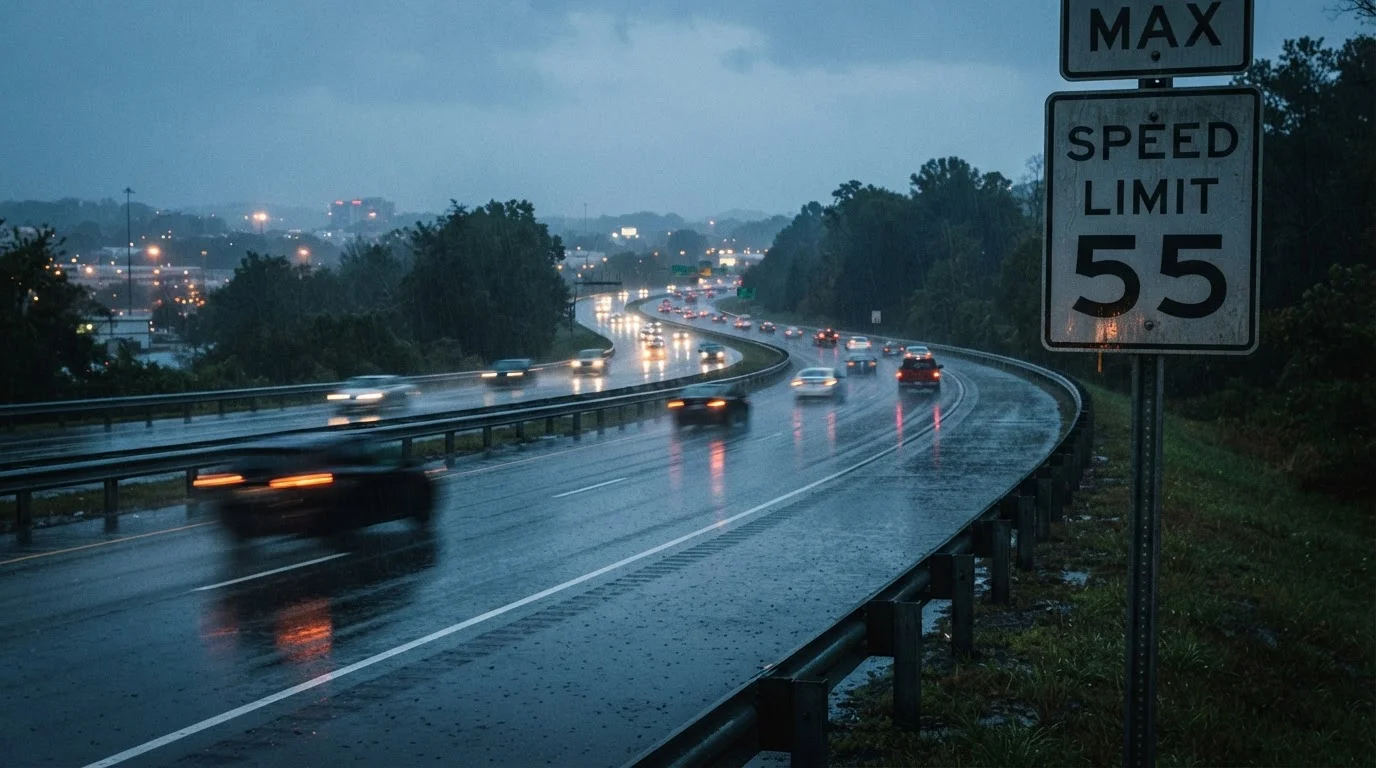
- Speed limit nuance: The posted number is a legal ceiling, not a target. Conditions frequently demand speeds well below the limit, particularly in rain, fog, or heavy pedestrian areas.
Warning Signs: Shapes and Colors That Signal Hazard
Warning signs in the US are almost always yellow diamonds - or orange during construction. Their specific symbols are where confusion creeps in:
Regulatory sign
A sign that communicates a legally enforceable rule of the road. Failure to comply can result in a traffic violation. Most are white with red or black text.
Warning sign
A sign that alerts drivers to a potential hazard or change in road conditions ahead. In the US, these are almost always yellow diamonds with black symbols.
Advisory speed
A non-legally-binding recommended speed, shown on a small yellow plaque below a warning sign. It represents the speed at which engineers determined a curve or ramp can be safely navigated.
Perceptual automaticity
A cognitive process in which the brain handles familiar stimuli without full conscious attention. In driving, it can cause experienced drivers to 'see' a sign without fully processing its specific instruction.
Lane control sign
An overhead sign, typically with arrow or X symbols, that controls which lanes are open or closed to traffic - commonly used in reversible lanes and HOV configurations.
MUTCD
The Manual on Uniform Traffic Control Devices - the federal standard published by the Federal Highway Administration (FHWA) that governs the design, placement, and meaning of all road signs, signals, and markings in the United States.
- Divided Highway Begins / Ends: These two signs are mirror images and frequently swapped in recall. Begins shows two lines diverging away from a central chevron; Ends shows them converging toward you. Getting these wrong on a two-lane road can lead to head-on exposure.
- Added Lane vs. Merge: An Added Lane sign means a new lane is being added alongside your lane - neither vehicle must yield. A Merge sign means two lanes are combining into one and someone must give way. Drivers who confuse these often fail to adjust speed appropriately.
- Advisory speed plaques: A small yellow rectangular sign below a warning diamond - showing, for example, "35 MPH" - is not a speed limit. It's the suggested speed for safely navigating that specific curve or ramp. Legally, you may exceed it, but engineers calculated it using friction and geometry, so ignoring it has real consequences.
- School zone signs: The pentagon shape (five sides, pointing up) is unique to school zone warnings in the US. Speed reductions in school zones are typically time-restricted - during school hours or when children are present - and are separate from the standard school zone sign.
Night driving adds another layer of complexity - reduced visibility means less time to register and react to warning signs. Our guide on night driving habits covers techniques that help.
Guide and Information Signs: Not Just for Tourists
Green, blue, and brown signs provide directional and service information. Drivers often dismiss these as irrelevant unless they're lost - but several carry important operational meaning:
- Exit number signs: In most states, exit numbers correspond to the nearest milepost. Knowing this lets you calculate distance between exits without a navigation app - a useful fallback.
- Blue service signs: These indicate gas, food, lodging, or hospitals at an upcoming exit. The hospital symbol (white H on blue) is worth knowing, since it may be the fastest navigation cue in an emergency.
- Brown recreational signs: Brown signs indicate parks, historical sites, and recreational areas. They're easy to overlook - and missing a turn they indicate can mean missing a facility with limited re-entry options on divided highways.
- Lane control signs: Overhead signs with arrows or X marks govern individual lanes on reversible or high-occupancy vehicle (HOV) roads. A red X means that lane is closed to all traffic - it is not a suggestion. These are especially important in contraflow configurations. For motorway-specific lane rules, see our lane discipline reference guide.
If you find that signs more broadly reflect how much you've absorbed versus what you actually follow behind the wheel, our article on common first-year driving mistakes covers habits that form early and can persist for years.