The Keep-Left Rule: More Than Polite Driving
On any UK motorway, the default rule is straightforward: keep to the left-hand lane unless you are overtaking. This is not a suggestion - it is a legal requirement under Rule 264 of the Highway Code, which carries statutory force. Drivers should return to the left lane as soon as it is safe to do so after completing an overtake.
The practical reason matters as much as the legal one. Staying left keeps faster-moving traffic flowing through the outer lanes, reduces the risk of rear-end collisions caused by sudden braking, and gives emergency vehicles room to pass. When every driver defaults left, the motorway functions more efficiently for everyone.
It is worth noting that the 70 mph national speed limit applies across all lanes. Travelling in the right-hand lane at 70 mph does not make middle-lane occupation lawful - position and speed are separate obligations. For a fuller picture of how speed interacts with road conditions, see our guide on how road conditions affect safe speed.
Middle-Lane Hogging: The Law and the Consequences
Middle-lane hogging - occupying lane two continuously when lane one is clear - became an endorsable offence in England and Wales under the 2013 amendments to the Road Traffic Act 1988. Police can issue a Fixed Penalty Notice (FPN) of £100 and three penalty points without the case going to court. In contested cases where the matter proceeds to trial, fines can be significantly higher.
The offence falls under careless driving, the same category as tailgating and distracted driving. That classification reflects how seriously regulators view the disruption it causes: a hogging driver forces overtaking traffic into lane three unnecessarily, compresses available road space, and can provoke hazardous manoeuvres by frustrated drivers behind.
What to Do If You Spot a Middle-Lane Hogger
Do not tailgate, flash lights aggressively, or undertake - all of these create additional risk and could themselves attract a penalty. The correct action is to overtake using lane three if it is safe to do so, then return to lane two or one. If you believe a driver is creating a genuine hazard, you can report it to the police non-emergency line after you have stopped safely, though enforcement decisions rest with officers.
Enforcement has increased since variable-message signs on smart motorways began displaying lane-discipline reminders, and some forces use camera evidence to support prosecutions. Claiming ignorance of the rule is unlikely to help in court.
Undertaking: When Passing on the Left Is - and Isn't - Permitted
Undertaking means passing a slower vehicle on its left side. Rule 268 of the Highway Code advises drivers not to overtake on the left or move to a lane on the left to overtake. However, there are two recognised exceptions where moving into a slower-moving left lane is permissible:
- Queuing traffic: When traffic is moving slowly in queues and the lane to your left is moving faster than the lane you are in, you may continue in that lane even if it means passing vehicles to your right.
- Turning left: If you are preparing to turn left at a junction, it is appropriate to be in the left lane.
Outside these situations, deliberately steering left to pass a vehicle is undertaking and can constitute careless or dangerous driving depending on the circumstances. The distinction between the two offences rests on the degree of risk created - dangerous driving carries a mandatory disqualification on conviction.
If you encounter a middle-lane hogger, the correct response is to move to lane three to overtake, then return left - not to undertake, however tempting it may feel.
Middle-lane hogging
Travelling in lane two of a motorway continuously when lane one is clear, without undertaking an overtake. It is an endorsable offence under UK law.
Undertaking
Passing a slower vehicle on its left side in a way that is not permitted. Exceptions exist in queuing traffic or when turning left.
Contraflow
A temporary traffic management arrangement, usually in roadworks, where vehicles travel on the opposite carriageway using coned-off lanes.
All-lane running (ALR)
A smart motorway configuration where the hard shoulder is converted into a permanent running lane, increasing capacity but removing the traditional breakdown refuge.
Emergency Refuge Area (ERA)
A lay-by provided at intervals on smart motorways to replace the hard shoulder as a place of safety for broken-down vehicles.
Variable mandatory speed limit
A legally enforceable speed limit displayed on an overhead gantry sign. It overrides the national limit for as long as it is displayed.
Contraflows, Smart Motorways, and Variable Signs
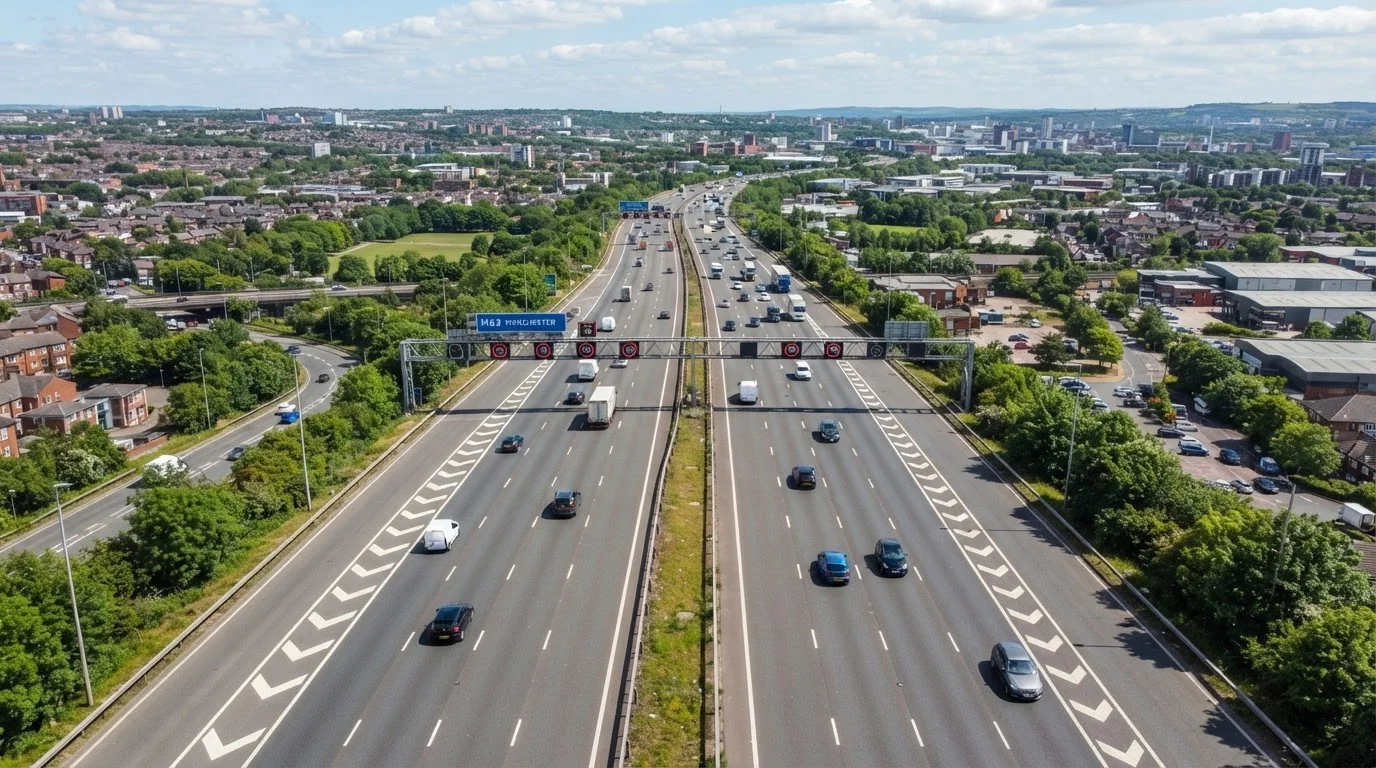
Contraflows are temporary arrangements - typically during roadworks - where traffic uses lanes on the opposite carriageway, often with reduced width and lower posted speed limits. Mandatory speed limits shown on red-bordered overhead signs within a contraflow are legally enforceable in the same way as permanent limits. Ignoring them is a speeding offence, not merely a guideline breach.
Smart motorways operate differently depending on their type. On all-lane running (ALR) schemes, the hard shoulder becomes a permanent running lane. A red X displayed above a lane means that lane is closed and must not be used - driving in a lane displaying a red X is an offence that can be captured by overhead cameras. Emergency refuge areas (ERAs) replace the hard shoulder at intervals and should be used if a vehicle breaks down.
Variable mandatory speed limits shown on overhead gantries apply regardless of the national limit; they take precedence the moment they are displayed. Conditions-based limits are not advisory - treat them as you would a fixed sign. For related guidance on adapting to difficult conditions, our article on driving in rain, fog, and snow explains how visibility and road surface change what safe driving looks like.
Understanding motorway signage clearly matters. If road signs in general feel less familiar than they once did, our guide to road signs you may have forgotten is a useful refresher.