Why free often means more authentic
Paid attractions are designed to scale. They process thousands of visitors a day, which means curated narratives, crowd management infrastructure, and experiences engineered for broad appeal. That's not a flaw — it's a function. But it does mean that what you encounter at a major ticketed site is often a version of a place rather than the place itself.
Free and low-cost activities operate on a different logic. Public markets exist to serve residents. Community events are organized for neighbors. Parks are built for daily use. When you participate in these spaces, you're not in a visitor-facing context — you're adjacent to ordinary life, which is where genuine cultural understanding tends to happen. This is especially relevant if you're exploring underappreciated US cities where the free infrastructure is often richer than the tourist circuit suggests.
Walk the neighborhoods locals actually live in
Tourist districts are designed for visitors, not residents. Venturing beyond them — on foot and without an agenda — exposes you to the textures that define a place: the corner bakeries, the way people dress, the noise levels, the pace of life. A two-hour walk through a residential neighborhood costs nothing and often teaches more than a half-day guided tour.
Look for areas near universities, food markets, or transit hubs. These tend to concentrate everyday activity and are generally safe and walkable. Keep a loose route in mind but allow room to follow what catches your eye.
A walk through a residential neighborhood costs nothing and often teaches more than a guided tour.
Visit public markets — especially on weekday mornings
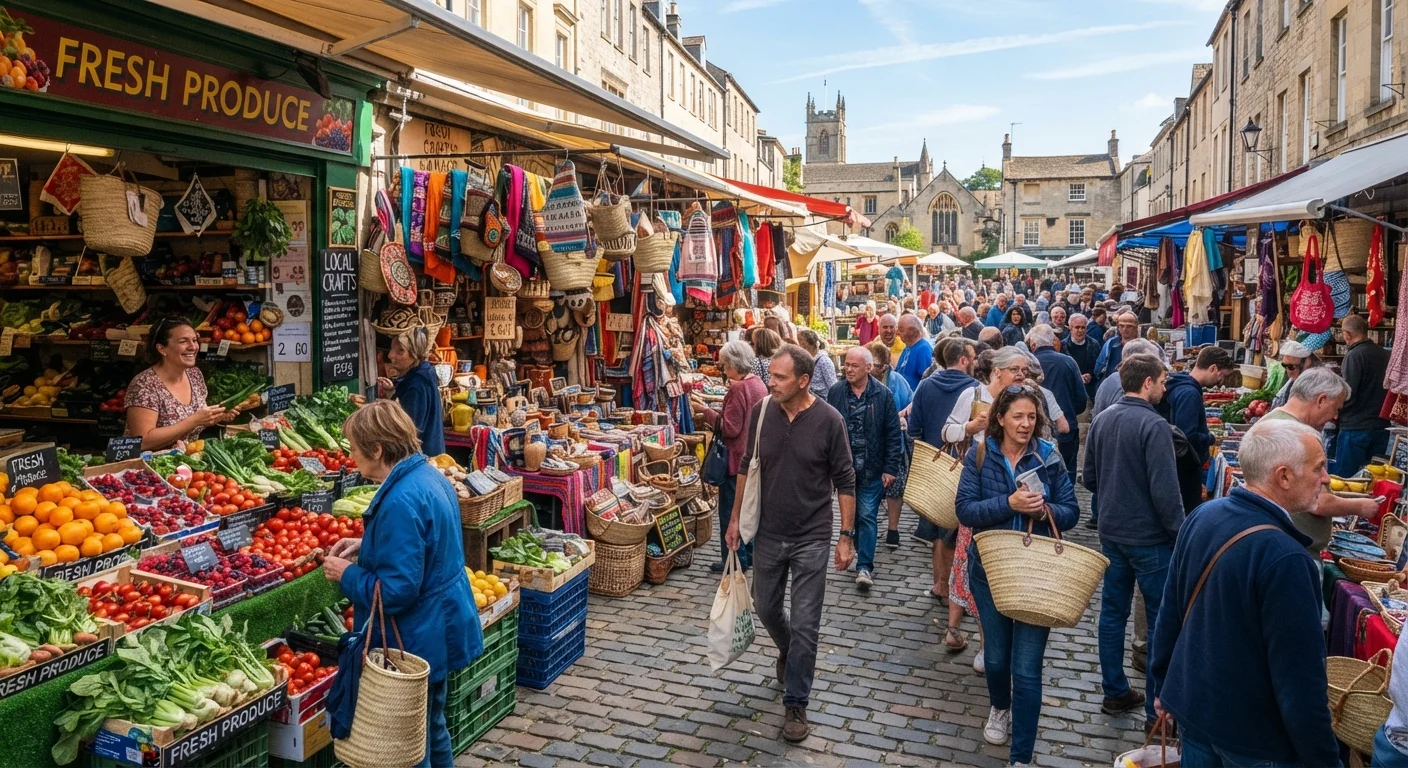
Farmers markets, fish markets, and covered food halls are where local economies and food cultures become visible. Watching vendors set up, hearing the languages spoken, noting what ingredients are in season — these observations build a portrait of a place that no museum can replicate.
Weekday mornings attract fewer tourists and more actual residents doing their weekly shopping. Sampling street food or a small snack from a stall is typically a few dollars at most, and often the most authentically local meal you'll eat on the trip.
Weekday mornings at public markets attract more residents than tourists — and far more authentic food.
Attend free community events and public programming
City governments, libraries, parks departments, and cultural organizations regularly host free concerts, film screenings, festivals, and lectures — particularly in warmer months. These events draw local audiences and offer a direct window into what a community values and celebrates.
Check local event listings via city websites, neighborhood Facebook groups, or community boards. Even showing up at a public plaza during a weekend afternoon often surfaces something unplanned: a street performance, a neighborhood fair, a pickup sports game. This kind of serendipity is hard to schedule but easy to find if you're present.
Free community events draw locals, not tourists — giving you a direct look at what a place actually values.
Use public parks as social observatories
Well-used public parks are some of the most revealing spaces in any city. On a Sunday afternoon, they show you how families spend leisure time, what sports are popular, how people dress casually, and how much social life happens in the open air versus indoors. That varies enormously from city to city and country to country.
Bring something to eat, find a bench or patch of grass, and spend an hour simply watching. This kind of unhurried observation is difficult to replicate in a ticketed attraction where you're moving through on a set path. Parks are also reliably free and accessible.
A Sunday afternoon in a public park reveals how a city actually lives — no ticket required.
Join free walking tours (and tip well)
Free walking tours — where guides work for tips — operate in dozens of cities across the US and internationally. They typically last two to three hours and cover historical context, neighborhood character, and local stories that guidebooks flatten into bullet points. The quality varies, but a good guide will contextualize a place in ways a self-guided stroll cannot.
Because compensation is tip-based, you decide what the experience was worth. A $10–$20 tip for a quality two-hour tour is still far less than a comparable paid experience. Look for tours organized through local tourism offices or well-reviewed community platforms — they tend to attract knowledgeable guides with genuine investment in their city.
A well-tipped free walking tour delivers local context at a fraction of the cost of a formal guided experience.
Explore free museum days and public cultural institutions
Many museums, galleries, historic sites, and botanical gardens offer free admission on specific days or during designated hours. Public libraries in major cities sometimes double as cultural institutions with rotating exhibitions. Government-funded museums — particularly those focused on natural history, science, or civic history — are frequently free to enter.
This isn't about hunting bargains for their own sake; it's recognizing that free cultural institutions tend to serve local audiences as a primary mission rather than international tourists. That distinction often translates into exhibits that are more local, more specific, and more illuminating than those designed for mass visitor appeal.
Free cultural institutions are built for local audiences — which makes them more revealing than tourist-focused paid sites.
Ride public transit like a commuter, not a sightseer
Taking a local bus or subway line during regular commuting hours — rather than a hop-on, hop-off tourist vehicle — puts you inside the daily rhythms of the city. The route itself may not be scenic, but the experience is genuinely local: the sounds, the density, the way strangers interact or don't, the stops people actually use.
A transit day pass is typically a few dollars and doubles as both transportation and informal cultural immersion. Riding a tram to the end of the line and back, or following a commuter bus through unfamiliar neighborhoods, is one of the more underrated ways to understand how a place functions.
Riding public transit like a commuter costs a few dollars and shows you how a city actually moves.
How to make the most of this approach
Build free activities into your trip framework
Rather than treating free activities as a fallback for budget days, plan them as your primary itinerary and layer in paid attractions selectively. This approach tends to produce richer experiences and forces you to engage with a destination on its own terms. For a broader framework on planning cost-conscious trips, see our end-to-end budget travel planning guide.
The practical challenge with free activities is that they require more planning flexibility than buying tickets in advance. Markets end by noon. Community events are seasonal. Free museum hours fill up. The solution is to research the rhythm of a destination before you arrive — not just what to see, but when local life peaks and where it concentrates.
Pairing low-cost activities with off-season travel timing amplifies the benefit further. Smaller crowds mean markets feel less performative, parks feel more genuinely local, and community events draw authentic neighborhood audiences rather than tourist overflow. Similarly, if you're planning an international trip, regions like Southeast Asia offer an environment where this approach stretches even further — where a few dollars buys a street food meal with more cultural depth than a restaurant designed for Western visitors.
Verify local conditions before you go
Market hours, free museum days, and public events can change seasonally or with little notice. Always confirm current schedules through official city or venue websites before building plans around them. Entry policies and programming details in this article are illustrative examples — actual availability depends on the specific destination and time of travel.
The goal isn't to avoid spending money on travel — it's to spend it where the return is highest. Freeing up budget by grounding your itinerary in low-cost, high-authenticity activities means you can direct resources toward the experiences that genuinely warrant the price of admission.