Your Brain on a Bargain
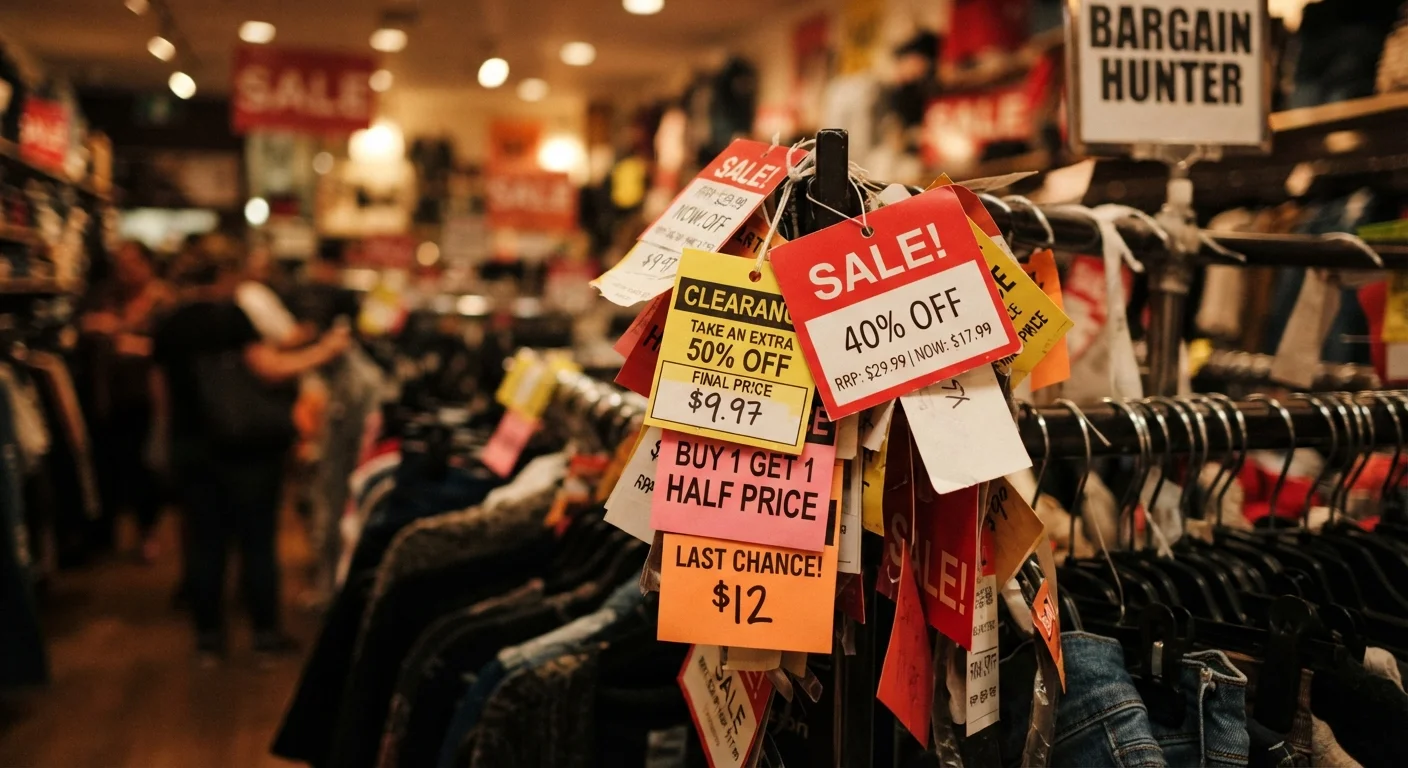
When a price tag reads $49.99 — down from $120, something specific happens in the brain: it registers not just a number, but a story about value. That story is largely constructed by the retailer, and it works whether or not the original price was ever real.
This is anchoring bias — the tendency to rely disproportionately on the first number encountered when making a judgment. Once $120 is planted in your mind, $49.99 feels like an escape from loss rather than simply a price. Behavioral economists have documented this effect across decades of research, and retailers have built entire pricing strategies around it.
Understanding these mechanisms doesn't require a psychology degree. It requires knowing that your instinct to grab a deal is being deliberately triggered — and that awareness alone can create a pause long enough to ask: Would I buy this at $49.99 if there were no $120 next to it?
~95%
Purchasing decisions driven by subconscious factors
Consumer behavior research, including work cited by Harvard Business School, suggests the large majority of purchase decisions are influenced by non-conscious mental processes rather than deliberate analysis.
2x
How much more losses hurt vs. equivalent gains
Kahneman and Tversky's foundational prospect theory research found people experience losses as roughly twice as painful as equivalent gains feel pleasurable — the basis of loss aversion in retail contexts.
↑ 40%
Increase in unplanned purchases during sale events
Retail industry research has consistently found that promotional events drive substantially higher rates of unplanned purchase behavior compared to standard shopping trips.
The Four Biases Retailers Count On
Sale events rarely rely on a single psychological lever. More often, several biases stack on top of each other, making resistance harder.
Loss Aversion
People feel the pain of losing something more acutely than the pleasure of gaining an equivalent thing. Framing a sale as 'don't miss out' exploits exactly this. Missing the deal feels like losing money you already had, even when you never planned to spend it.
Scarcity and Urgency
'Only 3 left' and countdown timers are not incidental design choices — they are deliberate triggers. Artificial scarcity shifts shopping from deliberate to reactive, bypassing the slower, more critical thinking that protects against regret. These same dynamics show up in car dealerships; our article on car-buying myths covers how urgency tactics play out in high-stakes negotiation environments.
The Decoy Effect
When a retailer places a poorly valued mid-tier option next to a premium one, the premium option appears more reasonable by comparison. You weren't considering the premium item — until the decoy made it look smart.
Transaction Utility
Economist Richard Thaler described how people derive pleasure not just from the thing purchased, but from the perceived quality of the deal itself. Buying something you didn't want, because the discount felt like a win, is a textbook example. This effect quietly inflates spending in ways that are easy to miss — the same pattern behind everyday habits that erode savings.
What 'Saving Money' Actually Means at the Register
The language of sales is built around savings, but the math often tells a different story. If you spend $80 on an item marked down from $150, you haven't saved $70 — you've spent $80 on something that may or may not have been in your plan.
Grocery environments are especially effective at obscuring this distinction. Unit pricing, multipack 'deals,' and loyalty card discounts that reset weekly create a sense of constant savings activity that doesn't always translate to a lower total bill. Our guide on hidden grocery costs breaks down the most common mechanisms in detail.
A simple reframe helps: money saved is money not spent on something you already planned to buy. Everything else is spending, regardless of the discount attached to it.
Use the 'Would I Buy It Full Price?' Test
Before adding a sale item to your cart, ask yourself whether you would purchase it at the non-discounted price. If the honest answer is no, the discount is doing the deciding — not you. This single question interrupts anchoring and transaction utility bias before they take hold.
Building Habits That Protect Against Sale Pressure
Willpower is an unreliable defense against purpose-built retail environments. Structural habits work better.
- Make a list before you browse. Intentional shopping dramatically reduces the surface area for impulse decisions.
- Check price history before acting on urgency. Many products run the same 'sale' price repeatedly. Knowing this deflates false scarcity.
- Apply a 24-hour rule to unplanned purchases. Most urgency-triggered desire fades quickly when you're outside the retail environment.
- Set a budget cap before entering sale events. A ceiling is easier to enforce than a willpower battle at the register.
For larger purchases, tracking price history over time is especially valuable. The price-tracking guide and how to evaluate discounts objectively offer concrete methods. And if you're working toward broader spending control, budgeting basics is a practical starting point.
This article is for general informational and educational purposes only. It is not personalized financial advice. Readers should consult a qualified financial professional for guidance specific to their situation.