Why Replace Grass in Some Parts of Your Yard?
Maintaining a uniform lawn across every square foot of your property can be expensive, time-consuming, and - in certain spots - a losing battle. Shaded areas under trees, slopes that are awkward to mow, and narrow side-yard strips are all places where turfgrass often struggles and demands disproportionate effort.
Ground covers are low-growing plants that spread horizontally to blanket the soil. In the right locations, they outperform grass in nearly every practical dimension: they need little to no mowing, they suppress weeds as they fill in, and many tolerate conditions - deep shade, dry soil, slopes - where lawn grasses fail. They also tend to require fewer inputs like fertilizer and irrigation once established.
The key phrase is low-traffic areas. Most ground covers are not built for repeated foot traffic the way turfgrass is. Think of them as a replacement for the parts of your yard that exist to be seen rather than walked on - borders, slopes, tree rings, and transitional spaces. For a broader look at reducing weekly yard work overall, see our guide to designing a low-maintenance yard.
Creeping Thyme
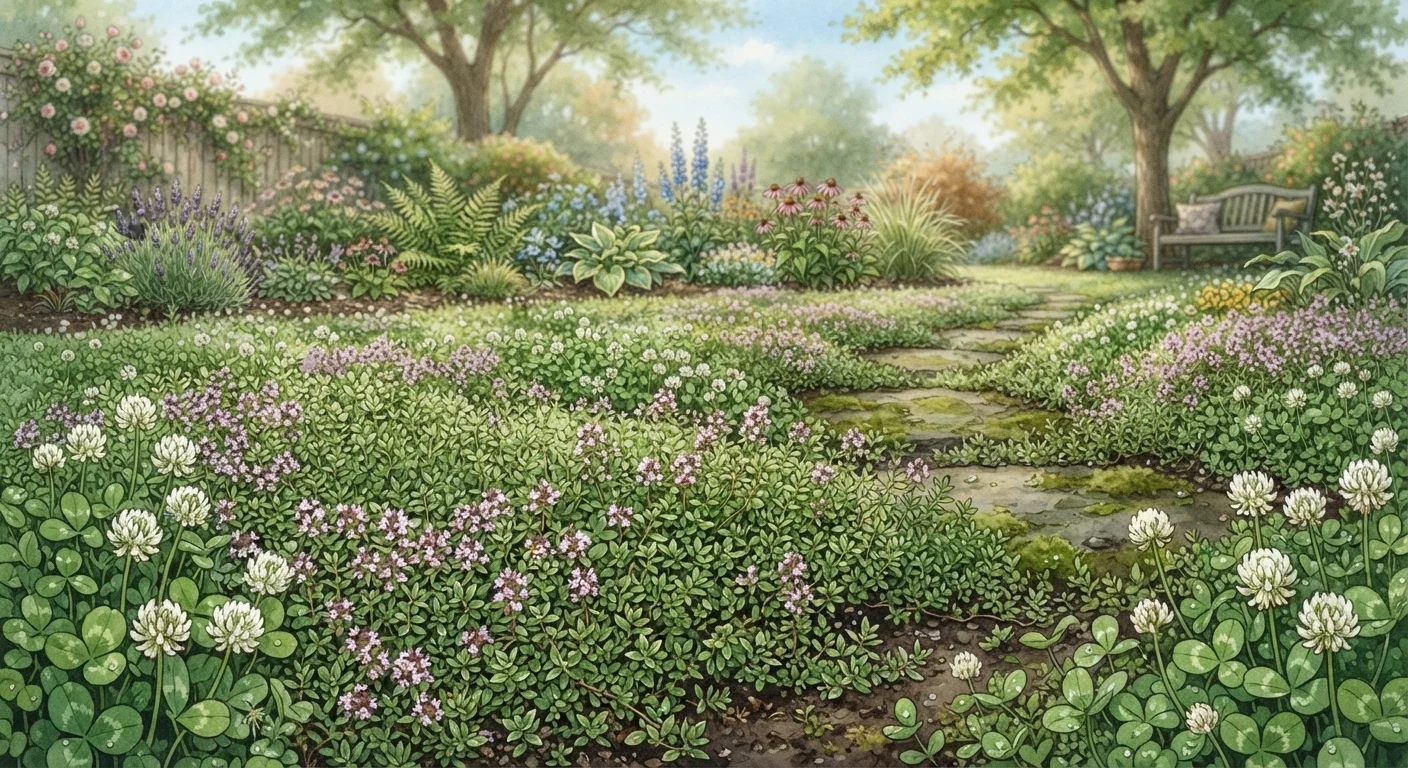
Creeping thyme (Thymus serpyllum and related species) is one of the most popular grass alternatives for sunny, well-drained spots. It stays low - typically just 2-3 inches tall - and produces small pink or purple flowers in early summer that attract bees. Once established, it's notably drought-tolerant, making it a strong choice for drier climates or slopes where irrigation is impractical.
It tolerates light, occasional foot traffic better than most ground covers, though it shouldn't be treated like a lawn path. It spreads slowly but steadily and stays tidy without any mowing. Full sun and good drainage are non-negotiable; it will rot in consistently wet or heavy-clay soils.
Creeping thyme thrives in sunny, dry spots and produces pollinator-friendly flowers with zero mowing required.
White Clover
White clover (Trifolium repens) has moved from lawn weed to intentional ground cover as homeowners recognize its benefits. It fixes nitrogen from the air into the soil, reducing or eliminating the need for fertilizer in areas where it grows. It stays green through drought conditions that leave turfgrass brown, and its small white flowers are a valuable food source for pollinators.
Clover works well in full sun to partial shade and tolerates a range of soil types. It spreads by both stolons (surface runners) and seed, so it fills in quickly. If you'd rather not have it seed into adjacent beds, mow it lightly after flowering. It pairs well with other low-growing plants in mixed ground cover plantings.
White clover fixes nitrogen into the soil naturally, potentially reducing fertilizer needs in covered zones.
Creeping Jenny
Creeping Jenny (Lysimachia nummularia) is a moisture-tolerant, shade-friendly option with bright chartreuse or golden-green foliage. It spreads quickly along the soil surface and looks lush even in areas that stay consistently damp - a condition that defeats most other ground covers. It's an excellent choice for low-lying spots, areas near downspouts, or shaded zones beneath large trees.
It does spread vigorously, so pair it with a solid edging border to keep it from migrating where you don't want it. In colder climates it may die back in winter but re-emerges reliably in spring. In warmer regions it often remains semi-evergreen. Note that it can become invasive in some areas near natural waterways - check local guidelines before planting.
Creeping Jenny thrives in damp, shaded spots where most ground covers and grasses give up entirely.
Ajuga (Bugleweed)
Ajuga (Ajuga reptans), commonly called bugleweed, is a semi-evergreen perennial that forms a dense, weed-suppressing carpet in partial to full shade. Its foliage comes in a range of colors - green, bronze, burgundy, or variegated - and it sends up spikes of blue-purple flowers in spring, adding seasonal interest without any extra effort.
It spreads by stolons and establishes relatively quickly, making it practical for larger shaded areas like the zone under a mature tree canopy where grass repeatedly fails. It handles occasional dry spells once rooted, though it performs best with moderate moisture. Like creeping Jenny, it can spread assertively, so a physical border is a wise precaution.
Ajuga's dense canopy suppresses weeds effectively in shaded spots where turfgrass chronically struggles.
Pachysandra
Pachysandra (Pachysandra terminalis for Japanese pachysandra, or the native Pachysandra procumbens) is a classic choice for deep shade under trees or on north-facing slopes. It forms a tidy, uniform carpet of dark green leaves that persists through winter in most of the country. Once established, it is remarkably low-maintenance - it rarely needs water, fertilizer, or trimming.
It spreads slowly compared to some other options, so initial spacing and patience matter. Consider starting with native pachysandra (Pachysandra procumbens) if you want to support local ecosystems - our piece on native plants versus ornamental imports discusses these trade-offs in more detail. Japanese pachysandra, while widely used, can become invasive in some regions.
Pachysandra is one of the most reliable evergreen ground covers for deep shade and low-input landscapes.
Moss
In areas with consistent shade and moisture - particularly in the Pacific Northwest or humid Southeast - moss can be encouraged as a living ground cover rather than fought as a nuisance. It creates a serene, soft aesthetic and requires no mowing, no fertilizer, and minimal maintenance once established. It's not planted in the traditional sense; it colonizes receptive surfaces naturally or can be encouraged by transplanting plugs from other spots in your yard.
Moss requires consistently moist, acidic soil and shade. If your soil is already too acidic for grass (a common reason for bare patches - see our article on what bare spots in your lawn are telling you), moss may colonize naturally with little intervention. It does not tolerate foot traffic well, so reserve it for purely ornamental zones.
Moss thrives in shady, acidic conditions where grass repeatedly fails - and it needs virtually no upkeep.
Getting Started With the Transition
Before planting any ground cover, you'll need to address the existing grass. Simply planting into existing turf rarely works - the grass will compete aggressively. Common removal methods include smothering with cardboard and mulch (sheet mulching), manual removal, or solarization using clear plastic sheeting in summer heat. Each method takes time, so plan your project at least a season ahead.
Once the area is cleared, prepare the soil by loosening it and amending with compost if it's compacted or nutrient-poor. Space plants according to package guidance - closer spacing speeds coverage, but plants naturally fill in over one to two growing seasons regardless. Consistent moisture during establishment is critical; after that, most of the options below become largely self-sufficient.
Establish Edges Before You Plant
Installing a physical edging barrier - metal, plastic, or stone - before you put plants in the ground is far easier than retrofitting one later. A well-defined border keeps spreading ground covers from creeping into adjacent beds or lawn areas and signals to anyone maintaining the yard that the planting is intentional. Even a simple spade-cut edge makes a meaningful visual difference.
Define your ground cover zones with a clean edge from the start. Crisp borders make the transition look deliberate rather than neglected. Our article on edging, borders, and pathways covers materials and layout approaches that hold up over time.