
The Three Numbers That Drive Every Lease Payment
Most drivers focus on the monthly payment when evaluating a lease offer. That number matters, but it's a result - not a starting point. Three underlying figures determine what you'll pay each month, and understanding them puts you in a far stronger position when you sit across from a finance manager.
Capitalized cost is the agreed selling price of the vehicle used in the lease calculation. Think of it as the "purchase price" the lease is built around. Unlike the residual value, this figure is negotiable. Dealers may also roll in additional fees - documentation charges, gap insurance, or add-ons - which increases the capitalized cost and, by extension, your monthly payment.
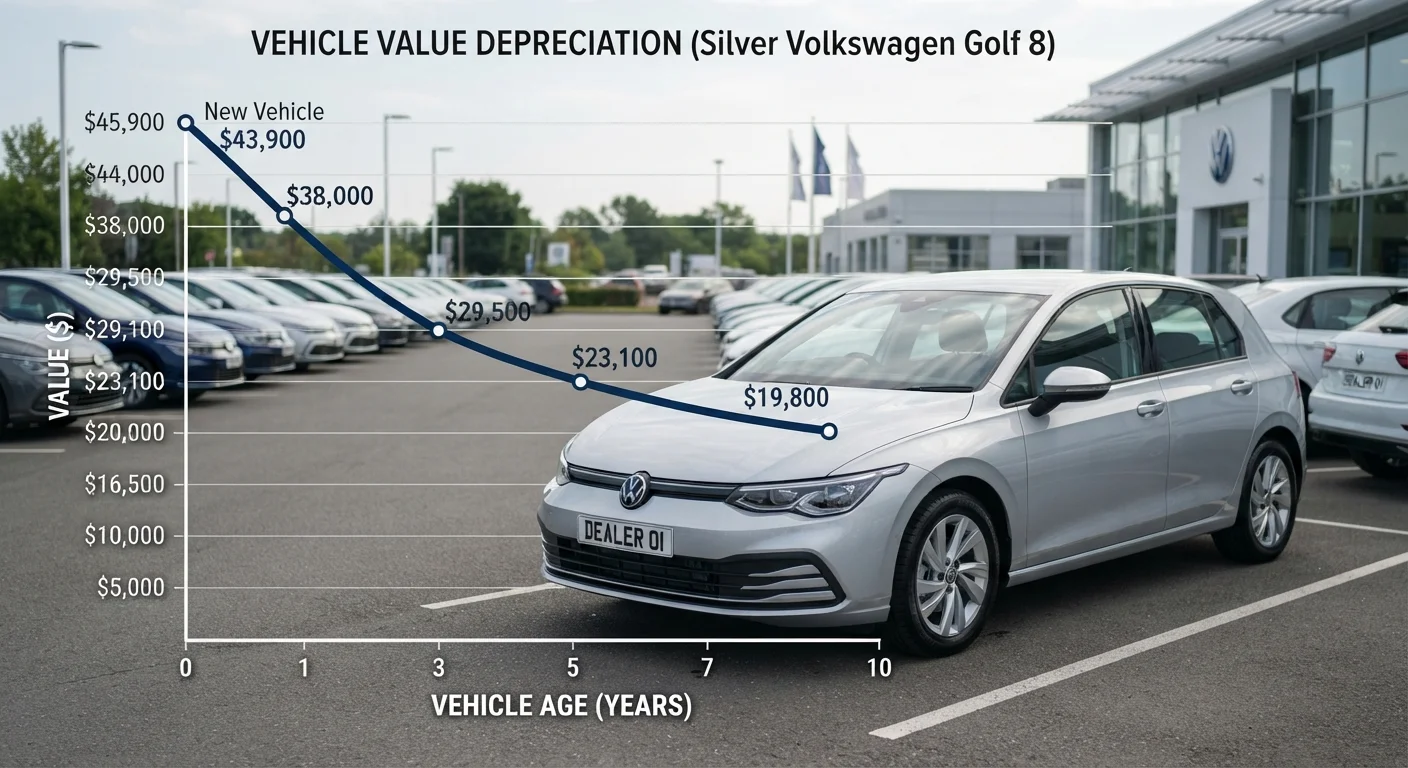
Residual value is the lender's projection of what the car will be worth at the end of the lease term. It's expressed as a percentage of the vehicle's Manufacturer's Suggested Retail Price (MSRP). If a $40,000 car has a 55% residual on a 36-month lease, the lender expects it to be worth $22,000 at term end. You're financing the $18,000 difference - plus financing charges. Understanding how vehicles depreciate helps explain why residual values vary so significantly by model.
Money factor is the lease equivalent of an interest rate. It appears as a small decimal (e.g., 0.00125) and represents the finance charge applied to the sum of the capitalized cost and residual value. Multiplying the money factor by 2,400 gives you the approximate APR - so 0.00125 equals roughly 3% APR. The base money factor is set by the lender but may be marked up by the dealer, so it's worth asking for it explicitly and comparing it against published rates.
~30%
Average new car depreciation in year one
Industry data consistently shows new vehicles lose a significant share of their value within the first 12 months - the primary cost a lessee finances.
2,400×
Money factor to APR conversion multiplier
Multiply any lease money factor by 2,400 to estimate the equivalent annual percentage rate and compare it to conventional loan rates.
$0.10-$0.30
Typical per-mile overage fee range
Most lenders charge between 10 and 30 cents per mile for every mile driven over the contracted annual limit at lease return.
How the Monthly Payment Is Actually Calculated
Once you have the three core figures, the monthly payment breaks into two components: the depreciation fee and the finance fee.
The depreciation fee is calculated by subtracting the residual value from the capitalized cost and dividing by the number of months in the lease. Using our example above: ($40,000 cap cost − $22,000 residual) ÷ 36 months = $500/month in depreciation.
The finance fee is calculated by adding the capitalized cost and the residual value, then multiplying by the money factor: ($40,000 + $22,000) × 0.00125 = $77.50/month in financing charges.
The base monthly payment before taxes is $500 + $77.50 = $577.50. Taxes, registration fees, and any optional add-ons are applied on top of that figure.
Ask for the Money Factor in Writing
Dealers are not always required to disclose the money factor proactively, and it can be marked up above the lender's base rate. Always ask for the exact money factor, convert it to an APR yourself, and compare it against what the manufacturer's financial arm publishes for that lease program. A small markup in the money factor compounds across the entire lease term.
This structure reveals why negotiating the selling price matters even on a lease - a $1,000 reduction in the capitalized cost reduces your depreciation fee by roughly $28/month on a 36-month lease, and also slightly lowers your finance fee. Over the full term, that $1,000 negotiation saves more than $1,000. For a broader view of what leasing costs compared to owning, see our comparison of buying vs. leasing.
Mileage Limits, Wear Standards, and End-of-Lease Costs
Lease agreements include a contracted annual mileage allowance - commonly 10,000, 12,000, or 15,000 miles per year. Exceeding that limit triggers per-mile overage fees at lease return. These fees are specified in the contract and can add up quickly if you regularly drive beyond your allotment.
If you know upfront that your driving habits exceed the standard limits, negotiating a higher mileage cap before signing is typically less expensive than paying overage fees at the end. Lenders charge a premium for additional miles upfront, but it's usually lower than the per-mile penalty rate.
Leases also define standards for acceptable wear and tear. Normal use - minor interior scuffs, small stone chips - is generally covered. Damage beyond those standards, such as significant dents, cracked glass, or worn tires, results in charges at vehicle return. Reviewing the lender's wear-and-use guidelines before returning the vehicle helps you avoid unexpected invoices.
Unfamiliar with some of the terms in your lease contract? A glossary of car-buying terms covers the key vocabulary you'll encounter, including gap insurance - coverage that matters if your leased vehicle is totaled before the term ends.
This article provides general educational information about how automotive leases are structured and is not personalized financial or legal advice. Consult a qualified financial professional regarding decisions specific to your circumstances.