What Minimum Payments Actually Do
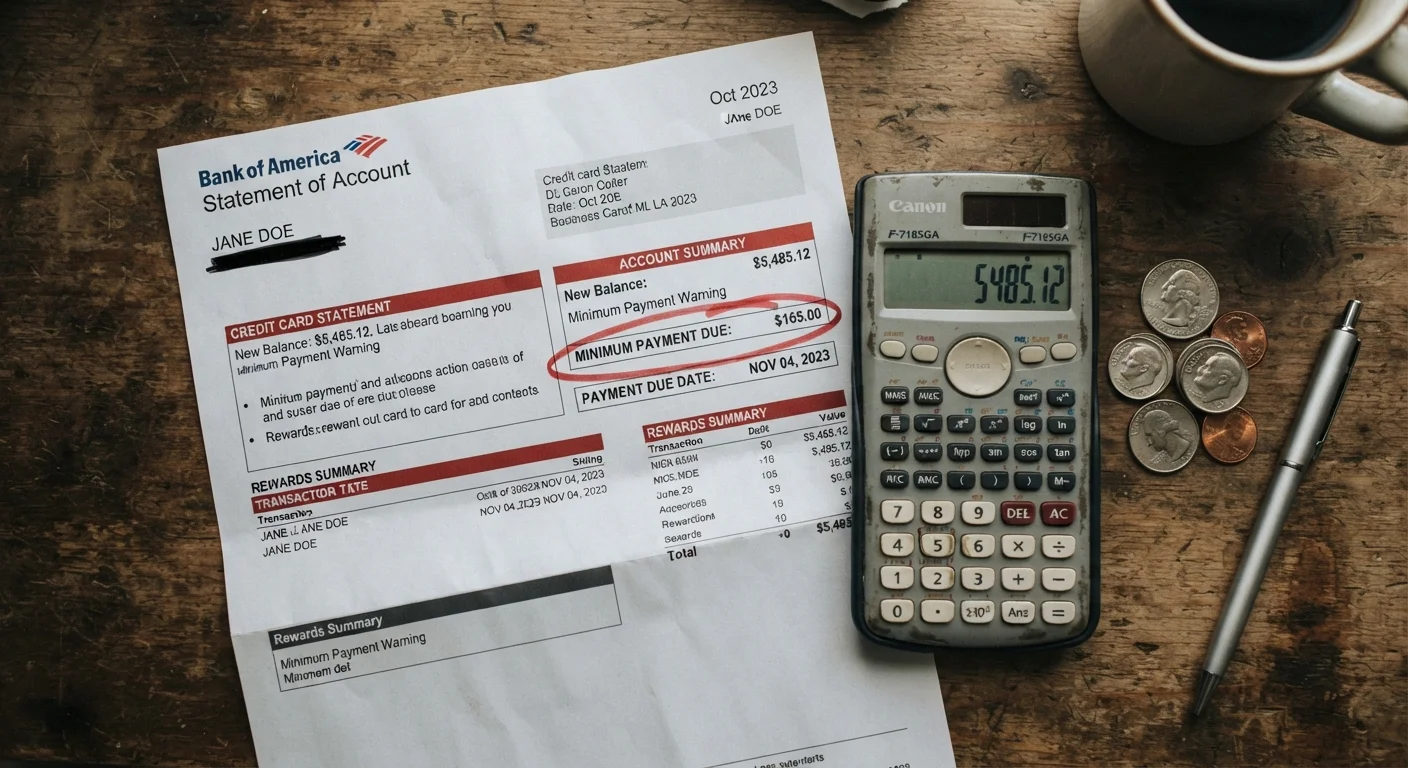
Every month, your credit card statement shows two numbers: the full balance and the minimum payment. The minimum is small by design — and that's exactly the problem.
When you pay only the minimum, you cover the interest charges and a thin slice of the principal. The bulk of your balance carries over, and interest accrues on it immediately. Next month, you're charged interest on a balance that's barely smaller than last month's. This cycle is how a modest purchase turns into a years-long financial obligation.
Credit card issuers are required by law (under the CARD Act of 2009) to print a "minimum payment warning" on statements, showing how long payoff takes — and how much it costs — if you pay only the minimum. That number often shocks first-time readers.
What the CARD Act Requires Lenders to Show You
Under the Credit CARD Act of 2009, U.S. credit card statements must include a minimum payment warning that discloses how long payoff takes — and the total interest cost — if you make only minimum payments. They must also show how much you'd need to pay monthly to clear the balance in three years. Look for this table on your statement; the numbers are often eye-opening.
The Maths: How Interest Compounds Against You
Here's a concrete illustration. Suppose you carry a $3,000 balance on a card with a 20% annual percentage rate (APR). Your issuer sets the minimum at 2% of the balance or $25, whichever is greater.
In the first month, the interest charge alone is roughly $50 (20% ÷ 12 months × $3,000). Your minimum payment might be around $60 — meaning only $10 goes toward the principal. The following month, interest accrues on $2,990, and your minimum drops slightly because the balance dropped slightly. This shrinking-minimum effect is what drags repayment out so long.
Running this formula forward: paying the minimum every month on that $3,000 balance at 20% APR takes over 14 years to pay off in full and costs roughly $3,200 in interest alone — more than the original balance.
Now compare: if you pay a fixed $100 per month instead, the same debt is gone in about 3.5 years and costs closer to $1,100 in interest. The difference is significant.
14+ years
Time to clear $3,000 at 20% APR on minimums
Illustrative calculation based on a 2%-of-balance minimum payment formula at a 20% annual interest rate.
$3,200+
Interest paid on a $3,000 balance at 20% APR
Paying only the minimum results in total interest charges that can exceed the original balance.
~3.5 years
Payoff time with fixed $100/month payment
On the same $3,000 balance at 20% APR, a fixed $100 monthly payment dramatically shortens the repayment timeline.
Why the Trap Is Easy to Fall Into
Minimum payments feel reasonable because issuers frame them that way. Statements highlight the minimum in large print; the total balance is there, but the psychological anchor is the smaller figure. For households managing tight budgets, that low number can seem like the only realistic option.
There's also a misconception that paying the minimum means you're handling the debt responsibly. You are avoiding default — but you're not making meaningful progress. The interest charges each month can equal or exceed the principal reduction, leaving you in place financially while still spending money every cycle.
This connects to a broader pattern: well-intentioned habits that quietly make debt worse. Minimum payments are one of the most common.
Round Up Your Payment as a Starting Point
If you can't afford a large lump sum, try rounding your payment up to the nearest $50 above the minimum. Even this modest step reduces principal faster, cutting interest charges in subsequent months. Over a year, small consistent additions compound in your favor rather than against you.
How to Break the Cycle
The most direct solution is to pay more than the minimum — as much more as your budget allows. Even an extra $20–$30 a month meaningfully shortens your payoff timeline because every additional dollar reduces the principal that interest is calculated on.
If you carry balances on multiple cards, a structured strategy helps you allocate extra payments where they do the most good. The debt avalanche and debt snowball methods offer two different frameworks — one optimizes for total interest saved, the other for motivation.
For a broader foundation, a beginner's roadmap to managing debt walks through the full process from listing balances to choosing a repayment path. And for the long game, habits that keep debt under control long-term can help you avoid returning to the minimum-payment cycle once you've broken free.
If your balances feel unmanageable, a nonprofit credit counseling agency — such as those affiliated with the National Foundation for Credit Counseling — can help you evaluate options at low or no cost. Consider consulting a licensed financial professional before making significant changes to your repayment approach.
This article is for general informational and educational purposes only and does not constitute personalized financial or legal advice. Consult a qualified financial professional regarding your specific situation.