
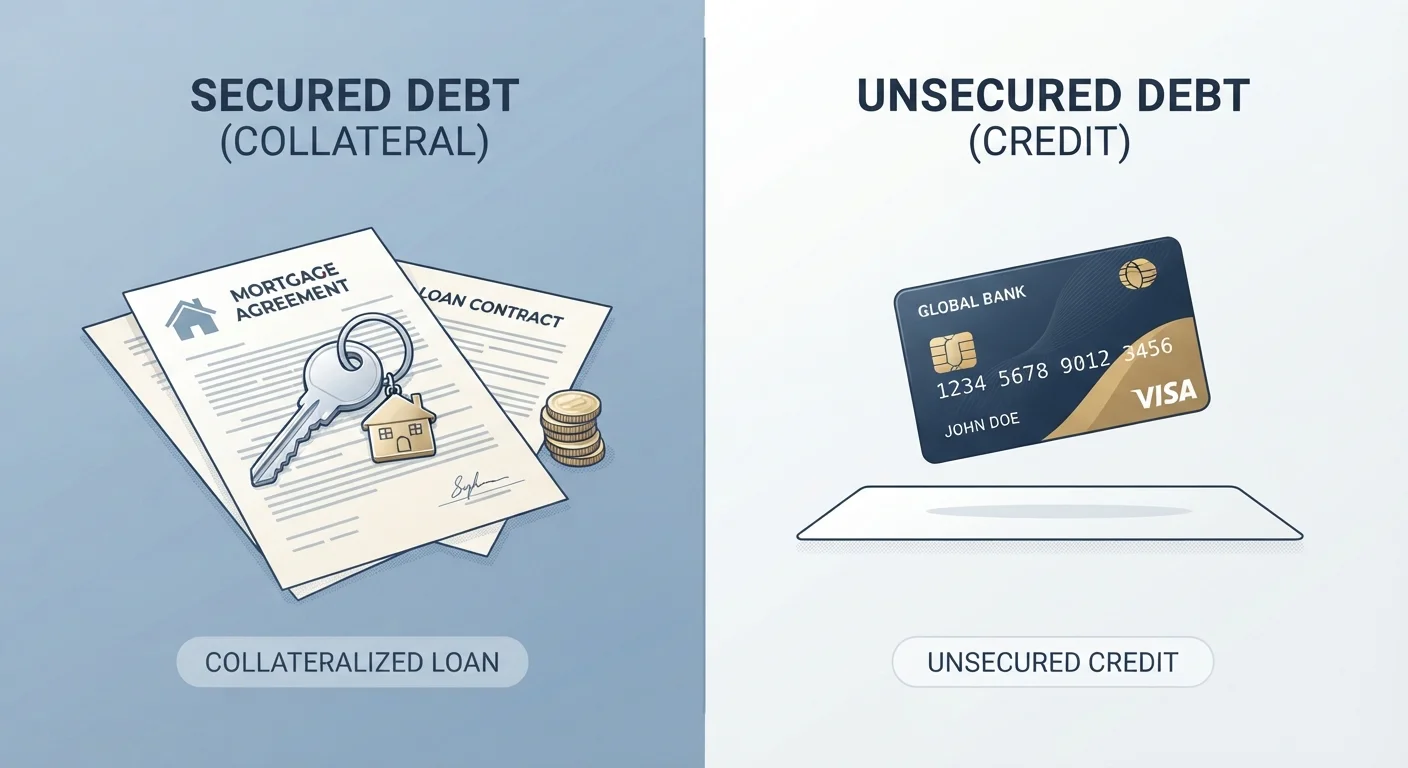
What Makes a Debt "Secured"?
A secured debt is one where you agree — in writing — that the lender can take a specific asset (called collateral) if you fail to repay. The asset acts as a backstop for the lender. The two most common examples in American households are mortgages, where the home is the collateral, and auto loans, where the vehicle serves that role.
Because the lender has a concrete claim on something of value, they face less financial exposure if things go wrong. That reduced risk typically allows them to offer lower interest rates. It's a direct trade-off: you accept the possibility of losing an asset in exchange for more favorable borrowing terms.
For a deeper grounding in these concepts, the glossary of key debt terms covers collateral, liens, and related terminology in plain language.
| Criterion | Secured Debt | Unsecured Debt |
|---|---|---|
| Collateral required | Yes — a specific asset pledged | No collateral needed |
| Typical interest rate | Generally lower | Generally higher |
| Common examples | Mortgage, auto loan | Credit card, personal loan, medical bill |
| Default consequence | Asset seizure (foreclosure, repossession) | Credit damage, collections, possible judgment |
| Lender risk level | Lower — asset backstop exists | Higher — no direct asset claim |
| Typical repayment term | Often long-term (15–30 years for mortgages) | Shorter fixed terms or revolving |
What Makes a Debt "Unsecured"?
Unsecured debt carries no collateral. The lender extends credit based primarily on your credit history, income, and overall financial profile — not on a specific asset they can claim. Credit cards, most personal loans, medical bills, and student loans (in most cases) fall into this category.
Without a safety net, lenders take on more risk. They compensate with higher interest rates and stricter credit requirements. If you stop paying, they can't immediately seize property. Instead, they typically report the delinquency to credit bureaus, pursue collection efforts, and may eventually sue to obtain a court judgment — which can then lead to wage garnishment depending on your state's laws.
~$6,500
Average US credit card balance per holder
According to Federal Reserve data, revolving consumer credit — primarily credit cards — represents a significant share of American household unsecured debt.
10–15 pts
Typical APR gap between mortgages and credit cards
Historical Federal Reserve consumer credit data consistently shows credit card rates running well above secured loan rates, though exact spreads shift with monetary policy.
Understanding your mix of secured and unsecured debt matters enormously when you're building a repayment plan. Resources like the complete guide to managing debt and credit explore how to approach that full picture strategically.
What Happens When Payments Stop
The consequences of default diverge sharply depending on the debt type.
With secured debt, the lender has a direct legal path to your collateral. Miss enough mortgage payments and foreclosure proceedings can begin. Stop paying your auto loan and repossession can follow — sometimes with little warning. The timeline varies by lender and state law, but the outcome is concrete: you can lose the asset.
With unsecured debt, the consequences are serious but different. Your credit score takes damage that can persist for years, limiting future borrowing. Persistent non-payment can lead to charge-off (where the lender writes off the debt as a loss), sale to a collection agency, and potential legal action. None of this is consequence-free — it's just a different category of harm.
During financial hardship, most financial education professionals recommend prioritising secured debts first to protect housing and transportation. The long-term debt management principles article outlines frameworks that help you make those calls systematically.
Interest Rates, Terms, and the Real Cost of Each
Interest rate differences between secured and unsecured debt can be substantial. Mortgage rates have historically run well below the average credit card APR — sometimes by 10 to 15 percentage points or more, depending on market conditions and individual credit profiles. That gap compounds significantly over years of carrying a balance.
Secured loans also tend to offer longer repayment terms, which lowers monthly payments but can increase total interest paid over time. Unsecured products like credit cards are revolving — you can carry a balance indefinitely, which makes them particularly costly if only minimum payments are made.
If you're managing multiple debts across both categories, repayment strategies matter. The debt avalanche vs. debt snowball comparison breaks down how to sequence payoff for maximum efficiency. And if combining debts seems appealing, what debt consolidation actually does offers a grounded look at the trade-offs involved.
This article is for general informational and educational purposes only and does not constitute personalised financial or legal advice. Consult a qualified financial professional for guidance specific to your situation.