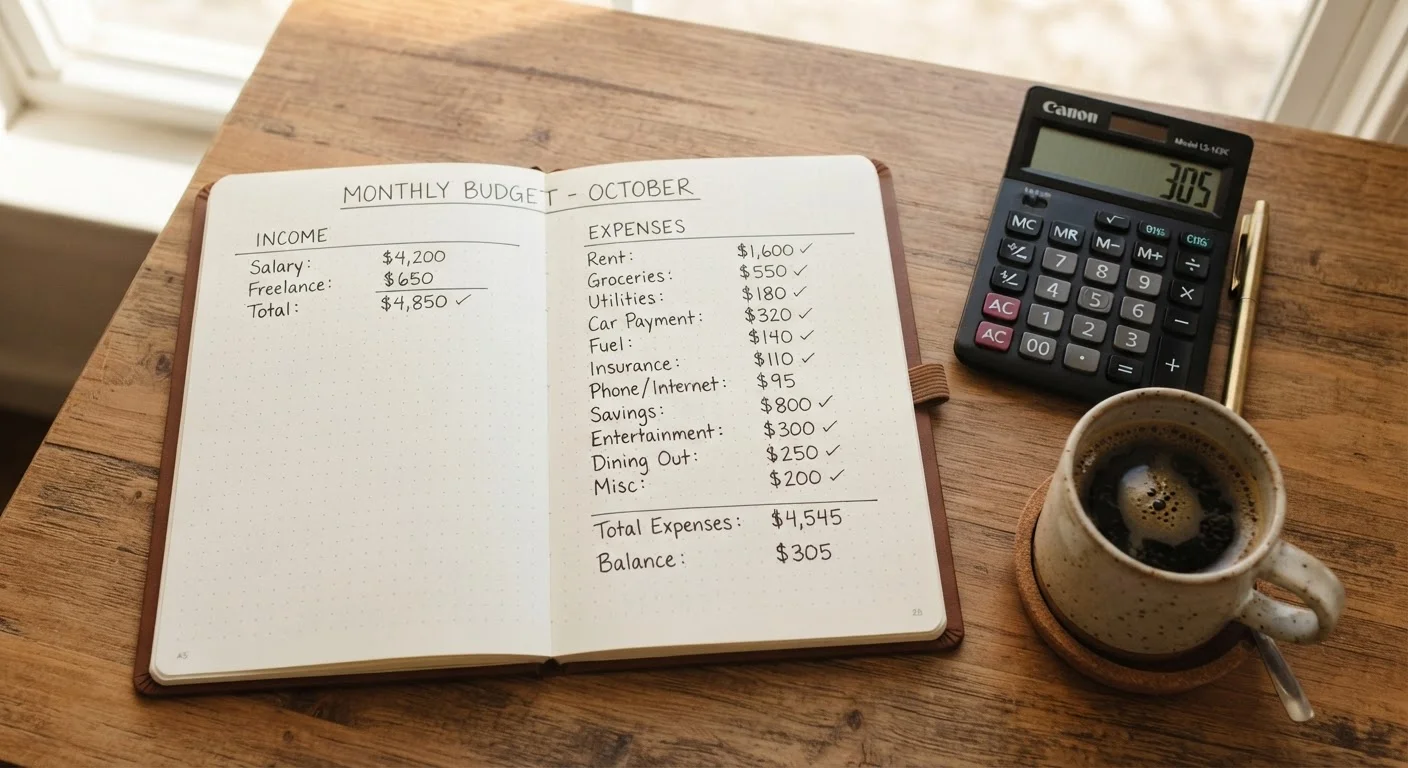

Why Most People Avoid Budgeting (And Why That Changes Today)
Budgeting has a reputation problem. Many Americans associate it with restriction, shame, or tedious spreadsheets — and so they skip it entirely. The result, for millions of households, is a nagging sense that money is disappearing without explanation.
The reality is more practical: a budget is simply a written plan for your money. It doesn't require perfection, financial expertise, or a high income. What it does require is an honest look at the numbers and a system you'll actually use. This guide walks through that process from start to finish, without jargon or judgment. If you're entirely new to the concepts, Personal Budgeting From the Ground Up covers the foundational vocabulary before you dive in here.
~74%
Americans living paycheck to paycheck
A 2023 LendingClub report found roughly three in four Americans reported spending most or all of their monthly income.
32%
Adults without any written budget
A Gallup survey found nearly one-third of U.S. adults do not maintain a household budget in any form.
$1,400+
Average monthly irregular expense per household
Research from the JPMorgan Chase Institute found significant month-to-month income and spending volatility in typical American households.
Step 1: Calculate Your Real Monthly Income
A budget built on the wrong number fails from the first line. Start with net income — the amount actually deposited into your account after taxes and deductions.
Don't Budget From Gross Pay
One of the most common early mistakes is building a budget around gross (pre-tax) income. Taxes, Social Security, Medicare, and benefit deductions can reduce your take-home pay by 20–35%. Always use your net, deposited amount as the foundation — otherwise every category in your budget will be overstated from day one.
If your income varies month to month — freelance work, tips, commission, gig platforms — use a conservative average based on your lowest three months over the past year. It's far better to plan around a floor than a ceiling. For households with multiple income streams, add each net figure separately before combining.
Step 2: Map Every Expense — Fixed, Variable, and Irregular
Most budget attempts collapse here because people only track the obvious: rent, car payment, utilities. The categories that quietly drain accounts are variable spending (groceries, gas, dining) and irregular expenses (annual subscriptions, vet bills, holiday gifts, car repairs).
Start With Last Month, Not Next Month
Before building a forward-looking budget, spend 20 minutes reviewing last month's bank and credit card statements. Categorize every transaction — even the ones that sting. This gives you a factual baseline rather than an optimistic guess, and it will reveal spending patterns you didn't know existed.
Organize expenses into three columns:
- Fixed: Same amount every month — rent/mortgage, loan payments, insurance premiums.
- Variable: Fluctuates but is monthly — groceries, fuel, utilities, dining out.
- Irregular: Infrequent but predictable — annual fees, medical copays, home maintenance, seasonal costs.
Divide your annual irregular expenses by 12 and treat that figure as a monthly line item. This is the single most impactful adjustment most budgeters can make.
Use your last three bank statements — not memory — to identify your true spending categories. Memory consistently underestimates discretionary spending by 20–30%.
Behavioral research shows people systematically underestimate how much they spend on dining, entertainment, and subscriptions when recalling from memory rather than reviewing records.
Create a dedicated 'irregular expenses' sinking fund and contribute a fixed amount monthly, even if it's small. Twelve months of small deposits beats one panicked lump-sum withdrawal.
Irregular but predictable expenses — annual insurance premiums, back-to-school costs, car registration — are the leading cause of budget blowouts for otherwise disciplined budgeters.
Step 3: Choose a Budgeting Framework That Fits Your Life
There is no universally correct budgeting method. Three frameworks work for most people:
- 50/30/20
- Allocate roughly 50% of net income to needs, 30% to wants, and 20% to savings and debt repayment. It's flexible and forgiving — a good starting structure for first-time budgeters.
- Zero-Based Budgeting
- Assign every dollar a job so income minus expenses equals zero. Requires more tracking but leaves nothing unaccounted for.
- Pay Yourself First
- Automatically move a set savings amount at the start of each month, then spend what remains. Works well for people who struggle with end-of-month leftovers.
None of these is inherently superior — the right one is whichever you maintain consistently. See our monthly budget setup checklist to translate whichever framework you choose into an actionable monthly routine.
Step 4: Set Realistic Savings and Debt Goals
A budget without goals is just accounting. Define what you're working toward: an emergency fund, paying off a credit card, saving for a down payment, or all three in sequence.
Build an Emergency Fund Before Aggressive Debt Payoff
Financial planners widely recommend keeping at least a small liquid emergency fund — often cited as $500 to $1,000 — before directing all surplus toward debt. Without it, a single unexpected expense forces you back into higher-interest debt, erasing your progress. Only after that buffer exists should you shift maximum resources toward debt elimination.
Once an emergency buffer exists, prioritize high-interest debt aggressively — it's one of the highest guaranteed-return moves available to a household budget. For a structured approach to tackling what you owe, Taking Charge of Debt: A Complete Roadmap for Beginners walks through repayment strategies step by step. For broader context on credit and debt management, explore the Debt & Credit hub.
Keep savings targets specific and time-bound. "Save more" is not a goal. "Save $2,400 over 12 months by setting aside $200 per month" is.
Step 5: Pick Your Tools and Build the Habit
Your budgeting tool should create as little friction as possible. Options range from a notebook to a spreadsheet to a dedicated app — each has genuine trade-offs. Pen-and-Paper Budgeting vs. Spreadsheets vs. Apps breaks down those trade-offs in detail so you can match the tool to your workflow.
Regardless of tool choice, a weekly 10-minute check-in — reviewing transactions, comparing to your plan, and flagging overspending before it compounds — is more valuable than any monthly review. Pair that with a monthly reset: adjust categories, account for upcoming irregular expenses, and revisit goals. The habits that make budgeting stick long-term are less about willpower and more about lowering the effort required to stay consistent.
Budgeting Is General Financial Education
The guidance in this article is for educational purposes only and does not constitute personalized financial, tax, or investment advice. Your specific situation — income, debt levels, family size, and goals — is unique. For decisions involving significant debt, retirement planning, or major financial changes, consult a qualified financial professional.
When Your Budget Breaks Down — And How to Reset
Every budget gets disrupted — a job change, an unexpected medical bill, a move. The goal isn't a budget that never breaks; it's developing the reflex to rebuild quickly.
When you go off track, avoid the all-or-nothing response. A single overspent month doesn't erase progress. Instead: identify what caused the breakdown (was it a one-time event or a structural mismatch between income and spending?), adjust the relevant categories, and recommit for the next 30 days. Over time, resets get faster and less stressful. For a ready-made structure when you need to start fresh, the monthly budget setup checklist works equally well as a reset tool. And when travel spending threatens to derail your plan, Building a Travel Budget That Actually Holds Up on the Road can help you keep trip costs from blowing your monthly numbers.
“A budget is telling your money where to go instead of wondering where it went.”
— John C. Maxwell, Author and leadership speaker
This article is for general informational and educational purposes only. It does not constitute personalized financial, tax, investment, or legal advice. Consult a qualified financial professional before making decisions based on your individual circumstances.