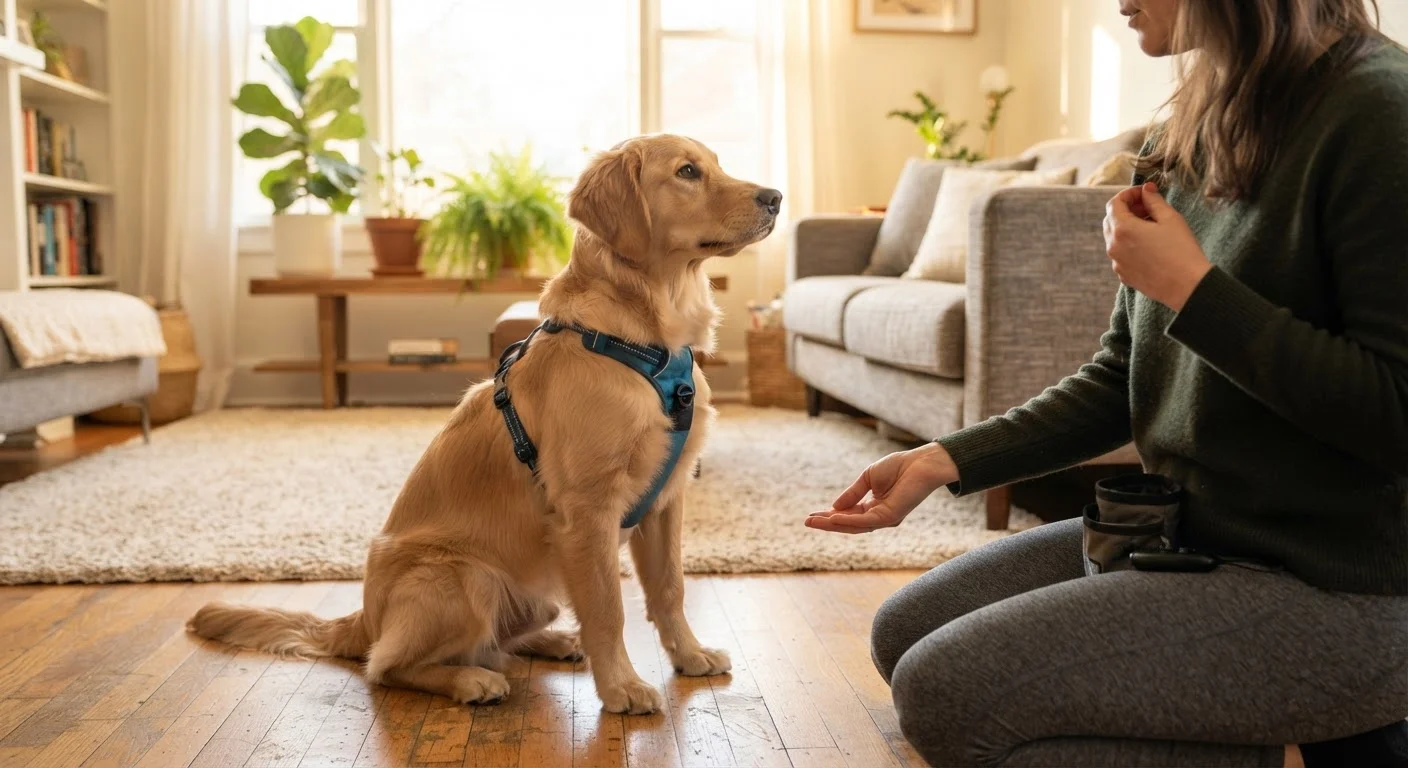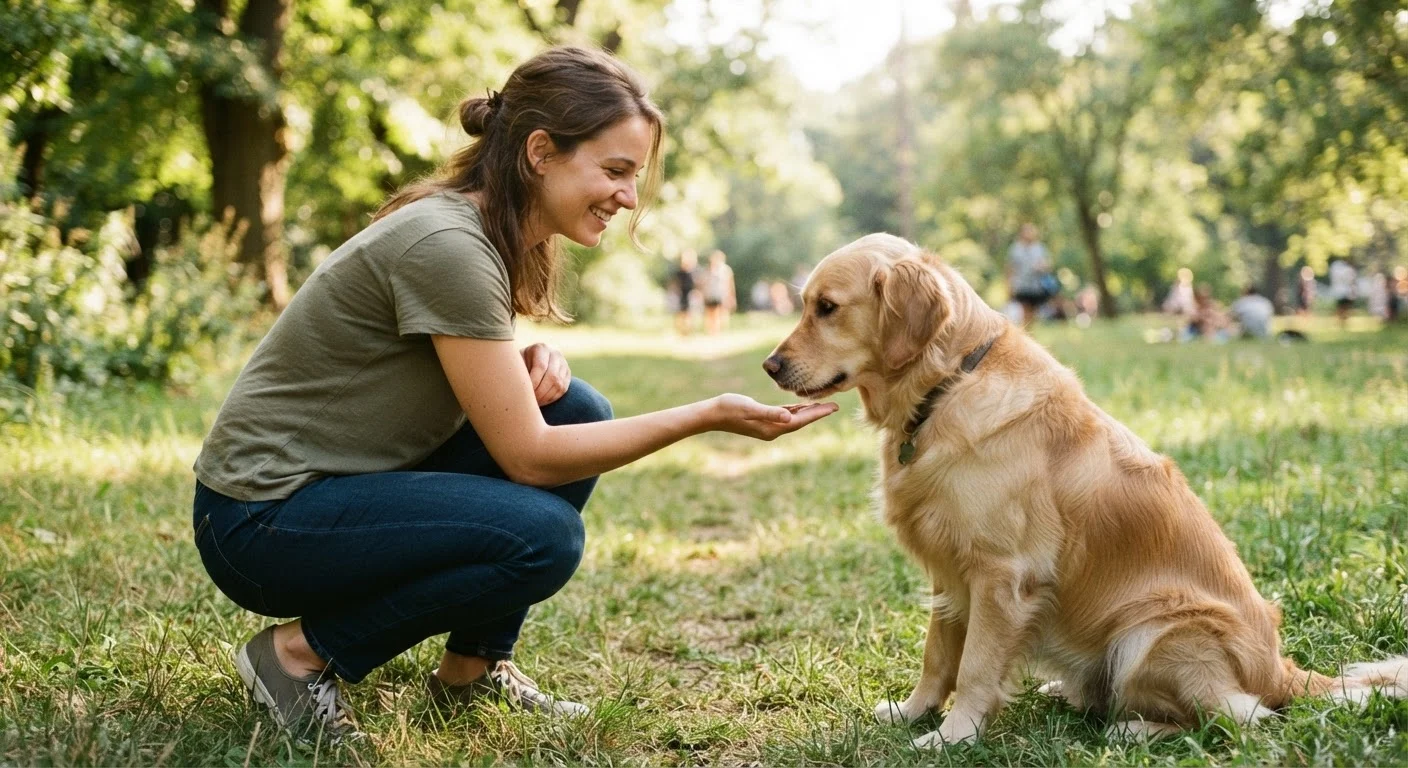

How Each Method Works
Both clicker training and verbal cues are forms of marker-based training — they signal to the dog the exact moment they've done something right. What differs is the signal itself and what that signal communicates.
In clicker training, a small handheld device produces a short, consistent clicking sound. Through a process called classical conditioning, the dog learns that the click predicts a reward. Once that association is established, the click becomes a precise "yes" — telling the dog exactly which behavior earned the treat. For a deeper look at why this works neurologically, see our guide to positive reinforcement science.
Verbal cues work similarly, but the marker is a word — commonly "yes" or "good" — followed by a reward. A verbal cue can also be the command itself ("sit," "stay," "come"), which is delivered before the behavior to prompt it. This dual role — prompting and marking — is what makes verbal communication both powerful and occasionally inconsistent.
| Criterion | Clicker Training | Verbal Cues |
|---|---|---|
| Signal consistency | Always identical sound | Varies with tone and emotion |
| Timing precision | Sub-second marking | Slightly slower delivery |
| Equipment needed | Clicker required | No equipment needed |
| Best training phase | Initial behavior acquisition | Maintenance and everyday use |
| Multi-person households | More uniform across handlers | Requires agreed-upon words and tones |
| Noise-sensitive dogs | May cause anxiety | Generally well-tolerated |
| Learning curve for owner | Requires practice to coordinate | More intuitive for most owners |
The Case for Clicker Training
The clicker's biggest advantage is signal consistency. The human voice naturally varies — you might say "good dog" warmly one moment and flatly the next, or with frustration bleeding through. Dogs are sensitive readers of tone, and those variations can muddy the message. A click always sounds the same.
Research in animal learning consistently supports event markers that are brief, distinct, and temporally precise. A clicker can mark a behavior in under half a second, which matters enormously when you're trying to capture a specific position or movement. This is why clicker training is widely used in professional and competitive dog training contexts.
~0.3 sec
Ideal behavior marker window
Animal learning research suggests markers delivered within roughly 0.3 seconds of the target behavior are most effective at building accurate associations.
2–3x
Faster skill acquisition with event markers
Studies on operant conditioning in dogs indicate that precise event markers can accelerate new behavior learning compared to delayed or inconsistent feedback.
~65%
Trainers using clicker methods professionally
Surveys of certified professional dog trainers have found a majority incorporate clicker or marker-based techniques as a core component of their training programs.
Clicker training also tends to produce what trainers call an "offered" behavior — dogs who are clicker-trained often become more experimentally minded, actively trying behaviors to see what earns the click. This can make training sessions feel more collaborative and mentally stimulating for the dog.
The Case for Verbal Cues
Verbal cues win on practicality. You always have your voice. In public spaces, on a hiking trail, or when your hands are full, a well-conditioned verbal cue delivers clear direction without requiring any equipment.
Once a dog has thoroughly learned a behavior — through whatever method — verbal cues maintain it reliably. Many trainers recommend a deliberate transition phase: use the clicker to build the behavior to a high level of fluency, then pair the verbal cue with it repeatedly until the word alone is sufficient to prompt the response.
Verbal cues are also more natural for most owners. For households where multiple people interact with the dog, agreeing on consistent words and tones matters far more than whether a clicker is present. Check our training consistency audit to assess whether your household is sending clear, unified signals.
Dogs who are noise-sensitive or have had negative associations with abrupt sounds may also respond better to a calm verbal marker from the start.
Combining Both Approaches Strategically
Most experienced trainers don't choose one method exclusively — they use both at different stages. A common framework looks like this:
- Acquisition phase: Use the clicker to teach the new behavior with maximum precision.
- Pairing phase: Introduce the verbal cue while the clicker is still in use, so the word becomes associated with the behavior.
- Maintenance phase: Fade the clicker and rely on the verbal cue for day-to-day prompting and reinforcement.
This approach leverages the clicker's timing advantage during learning and the verbal cue's convenience during everyday life. It also helps dogs generalize — performing a behavior in different environments and with different people.
Regardless of method, remember that the cue (click or word) only marks the behavior — the reward still does the reinforcing work. Removing treats too early is one of the most common training pitfalls. For a broader look at how these principles compare to other training philosophies, our article on reward-based vs. dominance-based training provides useful context.
As your dog's skills grow, watch for signs of genuine engagement rather than mere compliance — see our guide on signs your pet is thriving in training to recognize the difference.
This article is for general educational purposes and does not replace guidance from a certified professional dog trainer or veterinary behaviorist. If your dog shows fear, aggression, or significant behavioral challenges, consult a qualified professional.