
What Online Learning Actually Is - and Isn't
Online learning covers a broad spectrum: short skill-building workshops, full accredited degree programs, live instructor-led cohorts, and entirely self-paced courses you can start and stop at will. This variety is genuinely useful, but it also makes sweeping judgments about online education unreliable. The experience of completing a one-hour video tutorial is fundamentally different from enrolling in an accredited online degree program.
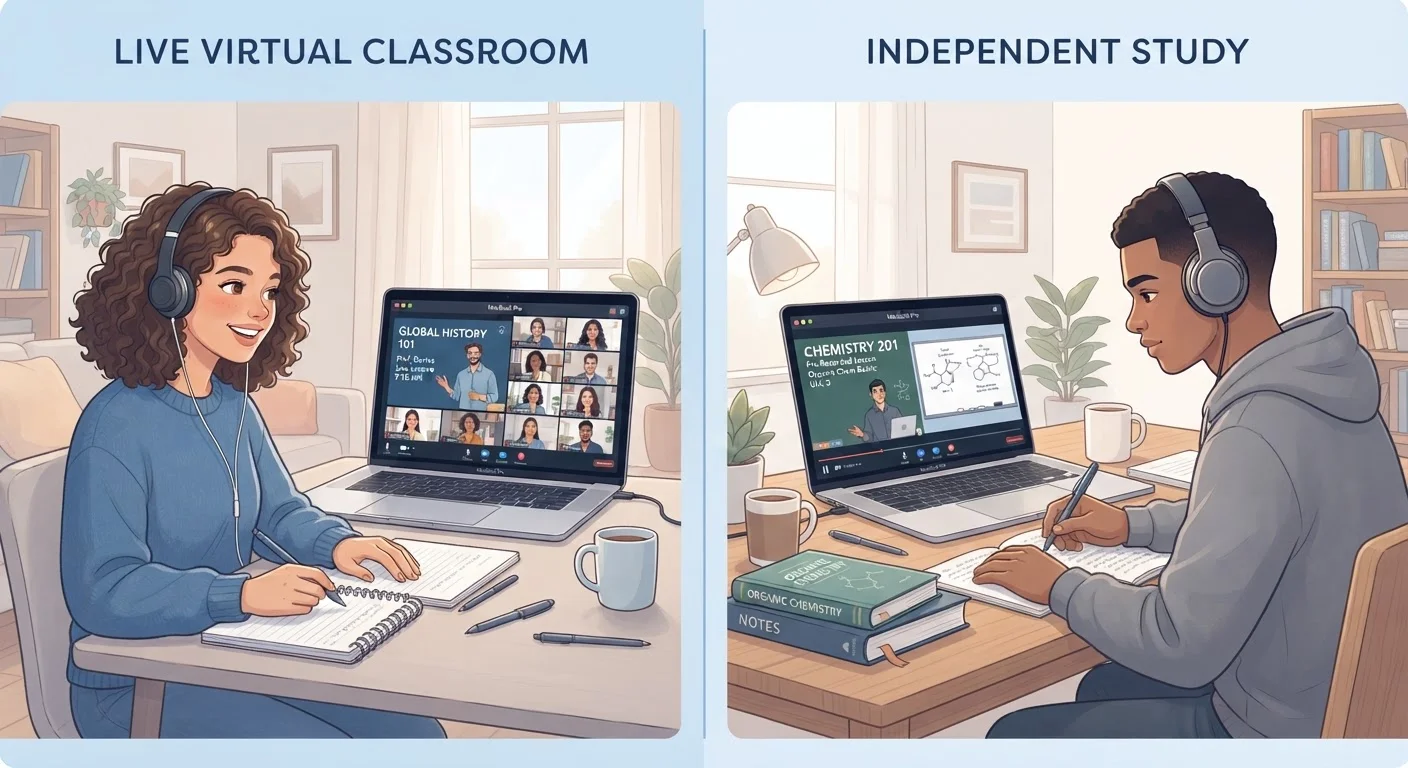
Before weighing pros and cons, it helps to recognize that format matters enormously. Understanding the difference between synchronous and asynchronous learning is one of the first distinctions worth making. Synchronous courses run on a fixed schedule with live sessions; asynchronous ones let you engage on your own timeline. Each suits different learners and different life situations.
For a broader map of how course formats align with specific goals, see our guide on matching learning formats to your goals.
The Genuine Advantages of Online Education
Online learning's strengths are not simply marketing language - several of them reflect structural realities that traditional classrooms genuinely cannot replicate.
Study on your own schedule from anywhere
Online learners can engage with coursework during evenings, weekends, or whenever their schedule allows, eliminating commutes and rigid timetables. This flexibility is especially valuable for working adults and caregivers.
Access to a wider range of subjects and instructors
Geography no longer limits what you can study or who teaches you. Learners in smaller cities or rural areas can access courses and expertise that would otherwise require relocation.
Many options are available at lower cost
Individual skill-based courses and open educational resources often cost significantly less than equivalent in-person instruction, making continuous learning more financially accessible for many people.
Self-paced formats suit different learning speeds
Learners who need more time on complex material, or who want to move quickly through familiar content, can adjust their pace in ways that traditional scheduled classes rarely allow.
Documented learning history and digital credentials
Many online platforms issue completion certificates or badges that learners can share with employers. These records create a verifiable trail of skill development over time.
5-15%
Typical completion rate for open online courses
Research published in peer-reviewed education journals has consistently found that completion rates for massive open online courses (MOOCs) fall in this range, though structured cohort-based programs tend to perform considerably better.
6.6M+
US students in distance education (pre-pandemic baseline)
According to National Center for Education Statistics data, millions of US college students were enrolled in at least some distance education courses even before pandemic-era expansions shifted the landscape further.
Accessibility is perhaps the most significant advantage. Geographic barriers disappear: a learner in a rural area can access the same course content as someone in a major city. Scheduling flexibility allows working adults, caregivers, and people managing health conditions to study around their responsibilities rather than restructuring their lives around a fixed timetable.
Cost is more nuanced. Many online courses, particularly individual skill-based modules on open platforms, cost far less than comparable in-person instruction. However, accredited online degrees from established universities can carry tuition that rivals on-campus programs, so it is important to compare specific options rather than assume online automatically means affordable. Our comprehensive online learning guide covers how to evaluate course quality and value.
The Real Limitations Worth Knowing Before You Enroll
Honest assessment of online learning requires confronting some structural challenges that affect a large proportion of learners, regardless of motivation.
Completion rates tend to be significantly lower
Without scheduled classes and in-person accountability, many learners - particularly in self-paced formats - disengage before finishing. This is a structural challenge of the medium, not just an individual willpower issue.
Hands-on and lab-based skills are harder to develop
Fields requiring physical practice - clinical procedures, laboratory work, performance arts, skilled trades - cannot be fully taught through a screen. Online formats can supplement but rarely replace hands-on instruction in these areas.
Peer networking happens less organically
In-person environments naturally generate professional connections and friendships through shared physical space. Building equivalent relationships online requires more intentional effort and is not guaranteed by enrollment alone.
Quality and rigor vary widely across providers
The online learning market includes both highly rigorous accredited programs and low-quality courses with little educational value. Learners must actively evaluate credentials, course design, and provider reputation rather than assuming all online offerings are equivalent.
Requires reliable technology and connectivity
Consistent broadband access, a functional device, and basic digital literacy are prerequisites that not all learners have equally. Technical disruptions can interrupt learning in ways that in-person classes are not subject to.
Completion rates are the most documented concern. Research consistently shows that self-paced online courses - particularly free ones on large open platforms - see a significant majority of enrolled learners drop out before finishing. This is not primarily a motivation problem; it reflects how self-directed learning requires a different kind of disciplinary infrastructure than a scheduled classroom provides. Our article on why online learners quit and what to do differently explores the evidence behind this pattern.
Social and collaborative learning also takes deliberate effort online. In-person environments generate spontaneous interaction, peer accountability, and networking naturally. Online formats can replicate some of this - discussion forums, group projects, cohort-based courses - but it rarely happens without intentional course design and active learner participation.
Accreditation: A Key Factor for Degree Programs
If you are considering an online program that leads to a formal credential or degree, accreditation matters significantly. Accredited programs have been reviewed against recognized educational standards, which affects whether employers and other institutions recognize your credential. Not all online programs are accredited, and the term 'certified' does not mean the same thing as 'accredited.' Always verify the accreditation status of any program you are considering through official sources before enrolling.
Making a Realistic Choice for Your Situation
The most useful question is not whether online learning is good or bad, but whether a specific online format matches your specific goal, learning style, and life circumstances. A highly structured, instructor-led online course may suit someone who struggles with self-direction. A fully asynchronous program may be the only viable option for a full-time professional. Self-paced vs. instructor-led online courses is a decision worth thinking through carefully rather than defaulting to whichever option is cheapest or most convenient.
For learners considering accredited credentials, it is worth understanding how employers view online degrees in your field. Our introduction to online degree programs for adult learners covers what accreditation means and what employers generally look for. If you are weighing online education against other pathways entirely, the comparison of vocational training and traditional degrees offers a useful side-by-side view.
One practical step: before enrolling in any online program, examine its completion support structures - whether it offers instructor feedback, peer cohorts, or progress checkpoints. These features consistently correlate with better learner outcomes, and they are worth treating as selection criteria rather than nice-to-haves.