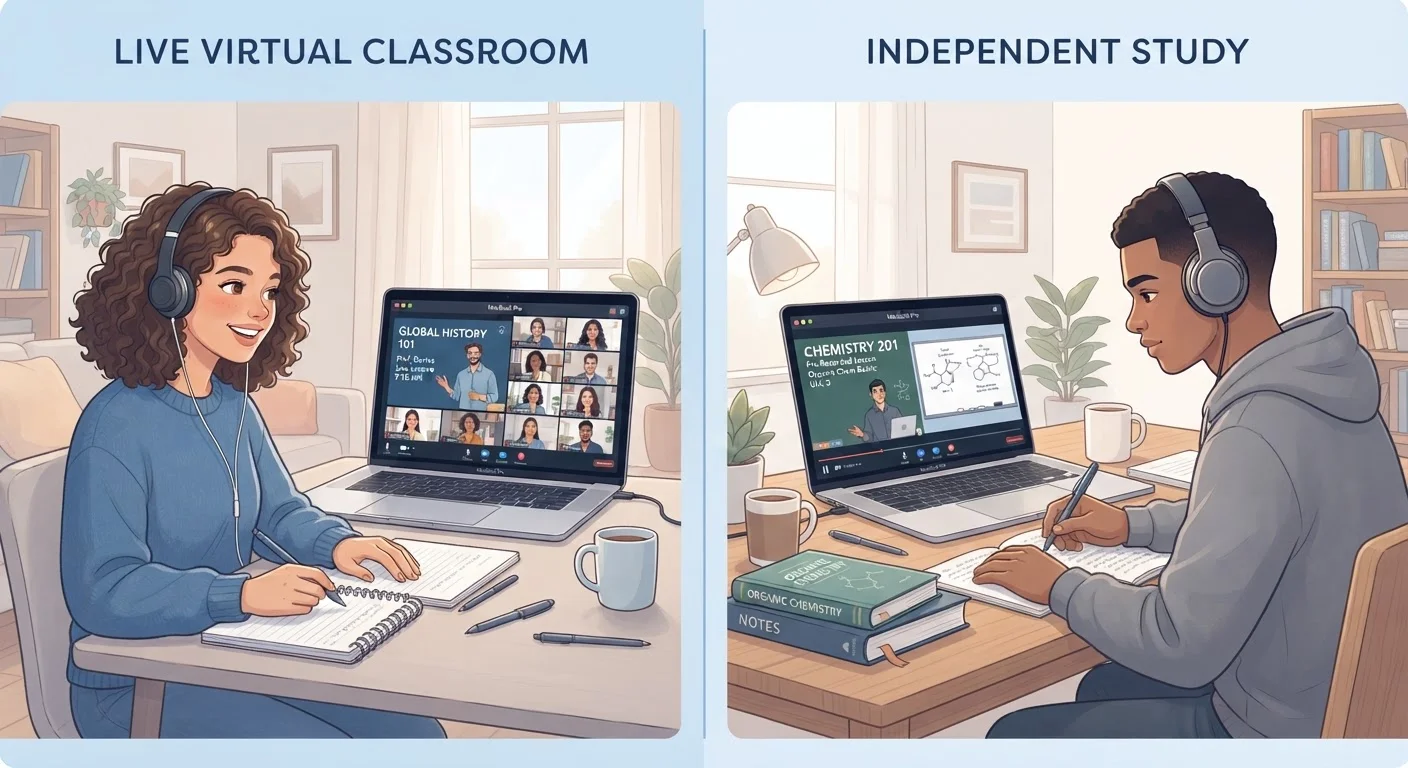

What Each Format Actually Means
The terms can feel self-explanatory, but the details matter when you are choosing where to invest your time. A self-paced online course lets you access all materials upfront - video lessons, readings, quizzes - and work through them on any timeline you choose. There are no live sessions and usually no hard deadlines. You control the pace entirely.
An instructor-led online course runs on a set schedule. A cohort of learners moves through the material together, often with weekly modules, assignments due on specific dates, live or recorded lectures, and opportunities to interact with both the instructor and peers. Some formats are fully synchronous (live sessions you attend in real time); others are asynchronous but still cohort-paced. For a deeper look at that distinction, see synchronous vs. asynchronous learning.
If you are new to online study altogether, this starter guide for beginners covers the foundational tools and terminology worth knowing before you enrol in either format.
Head-to-Head: How the Two Formats Compare
Understanding the practical trade-offs side by side helps clarify which structure suits your situation. Consider each of these dimensions honestly before enrolling.
| Criterion | Self-Paced | Instructor-Led |
|---|---|---|
| Schedule flexibility | High - learn anytime | Low to moderate - set dates |
| Accountability | Self-imposed only | Built-in via deadlines and instructor |
| Peer interaction | Minimal or none | Cohort discussions, group work |
| Instructor access | Usually limited (forums, FAQs) | Direct - live or scheduled feedback |
| Typical completion rates | Lower on average | Higher on average |
| Best subject fit | Exploratory or self-contained topics | Complex, sequential, or feedback-intensive |
| Cost range | Often lower or free to audit | Generally higher; varies widely |
One nuance worth noting: instructor-led courses vary widely in how much live interaction they actually include. Some are largely pre-recorded with only weekly discussion boards; others involve live video sessions several times per week. Always review the course schedule and format details before enrolling - a pre-enrolment checklist can help you ask the right questions.
The Completion Rate Problem - and Why Format Matters
Online course dropout rates are well-documented across the education research literature. Studies from institutions including MIT and Harvard examining massive open online courses (MOOCs) have found that a significant majority of enrolled learners do not complete them - with some estimates placing completion rates below 10% for open self-paced formats. Instructor-led courses with deadlines and peer cohorts tend to show meaningfully higher completion rates, though figures vary by subject, institution, and learner population.
< 10%
Completion rate for many open online courses
Research from MIT and Harvard examining large-scale open online courses found most enrolled learners do not complete the course.
~3x
Higher completion likelihood with accountability structures
Education researchers have consistently found that external accountability - deadlines, peer cohorts, instructor feedback - is associated with significantly higher completion.
The structural reason is straightforward: self-paced courses remove friction for entry, but they also remove the social and deadline-driven pressure that motivates many people to finish. If you have previously abandoned online courses, that is a useful data point about the format you need - not necessarily about your capability. Research on why online learners quit identifies accountability as a consistent factor.
If you do choose self-paced, building your own structure is essential. Building a personal study routine is a practical step you can take to compensate for the absence of external deadlines.
Matching the Format to Your Learning Goals
Format choice should follow your purpose. If you want to explore a broad topic casually - say, learning the basics of graphic design or picking up a new language - a self-paced course offers a low-stakes starting point. If you are working toward a credential, preparing for a professional exam, or learning a skill that requires feedback (like writing, coding, or public speaking), instructor-led environments tend to serve those goals better.
Subject complexity is also a factor. Highly technical or sequential subjects - where each concept builds on the last - benefit from guided pacing. An instructor can identify where a cohort is struggling and slow down; a self-paced video cannot adapt to you in the same way.
Cost Is Not the Whole Picture
Self-paced courses are often cheaper or available to audit for free, which can feel like a straightforward win. But free courses carry their own hidden costs - including time invested in a course you may not finish, and fees required to earn a certificate. Factor in the value of completion, not just the enrolment price, when comparing options.
For a broader view of how different online formats align with different learning objectives, matching learning formats to your goals covers short workshops, cohort courses, and full degree programmes in context. You might also want to explore our comprehensive online learning resource for end-to-end guidance on navigating self-directed education.
This article is for general informational and educational purposes. Individual learning outcomes vary based on personal effort, prior knowledge, course quality, and many other factors. No specific results are guaranteed.