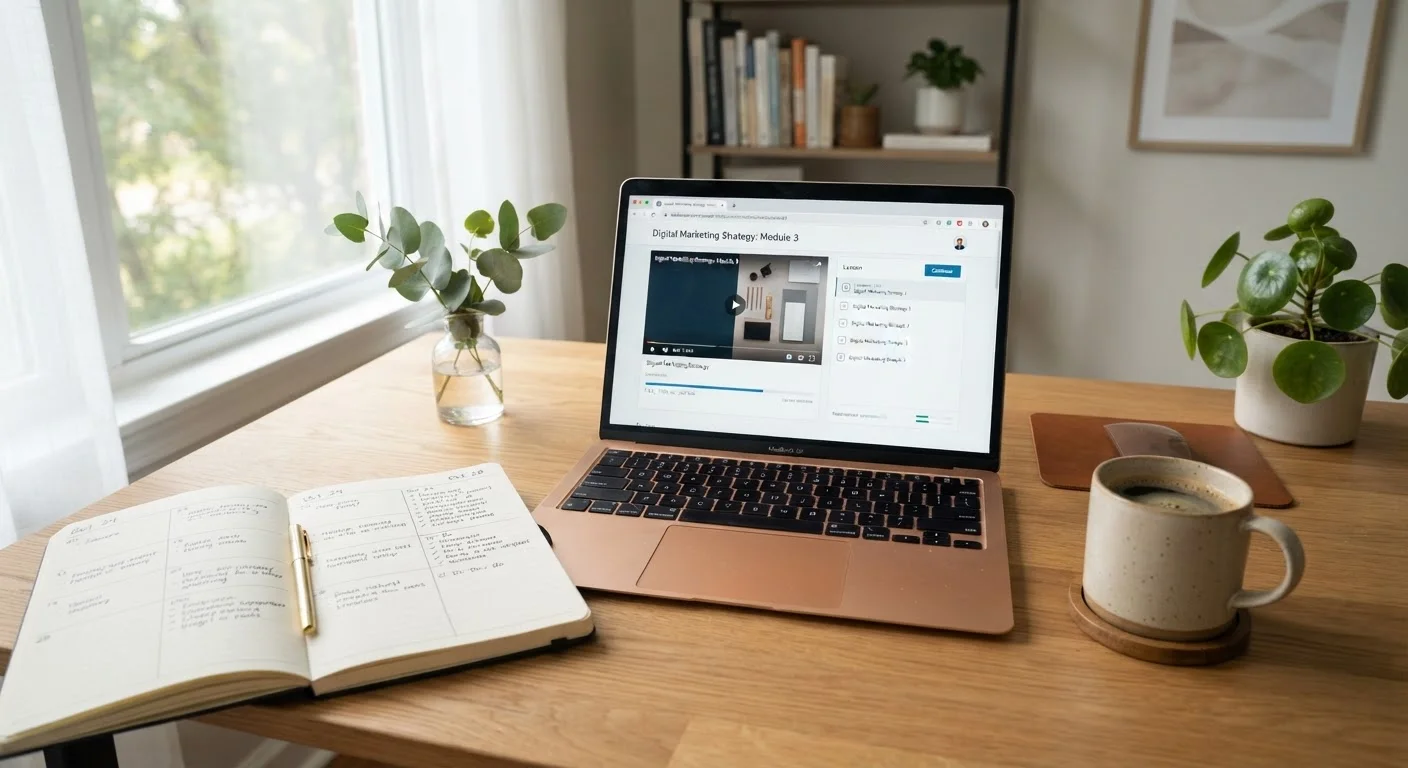

Why Video Learning Demands a Different Approach
Video lectures have become the backbone of online education, yet most people watch them the same way they watch entertainment - passively, in one sitting, without pausing. Research on cognitive load and memory encoding consistently shows that passive viewing produces shallow retention, even when the content feels clear in the moment.
The problem is a phenomenon sometimes called the illusion of knowing: because the instructor explains something fluently, it feels understood. But understanding while watching is not the same as being able to recall or apply that knowledge later. Effective video-based learning requires deliberate effort before, during, and after each session.
If you are new to self-directed study, the starter guide for absolute beginners provides useful grounding in the habits and tools that support any format of online course.
Best Practices for Active Video Watching
The following practices are grounded in how memory and attention actually function. Applying even a few of them consistently will produce measurably better outcomes than uninterrupted passive viewing.
Preview the video's structure before pressing play.
Knowing the outline of a lesson in advance activates relevant prior knowledge and gives your brain a framework to hang new information on. This reduces cognitive load during watching and improves comprehension of how individual points connect.
Watch in shorter segments with deliberate pauses, not as a continuous stream.
Attention and working memory fatigue over time. Watching 10-15 minute segments with intentional breaks allows the brain to begin consolidating information rather than simply buffering an ever-growing queue of unprocessed input.
Adjust playback speed thoughtfully rather than defaulting to the fastest setting.
Speeding up video can save time, but research on processing fluency suggests that very high speeds reduce comprehension of complex or unfamiliar material. Speed works best for review, not first exposure.
Eliminate competing stimuli in your viewing environment.
Divided attention is one of the most reliable ways to degrade learning. Notifications, background conversation, and second screens all compete with the cognitive resources required to process and encode new information.
Explain the core idea aloud to yourself after each video segment.
The 'teach-back' technique - articulating a concept as if explaining it to someone else - is a high-efficacy retrieval practice that surfaces gaps in understanding immediately, while the material is still fresh.
Connect new content explicitly to something you already know.
Meaningful learning depends on linking new information to existing schemas. When new material is isolated in memory with no connections, it is far more vulnerable to forgetting.
Pairing these habits with a reliable study routine amplifies their effect. The article on building a personal study routine explains how to schedule sessions realistically and maintain consistency over time.
Note-Taking Strategies That Work for Video
Standard note-taking habits developed in classroom settings often transfer poorly to video learning. In a live lecture, social pressure and pacing cues encourage engagement. Video removes both. Without intentional structure, notes from video tend to be either too sparse to be useful or near-verbatim transcriptions that consume attention without aiding memory.
Try the Pause-and-Summarise Method
After each major concept in a video, pause playback and write a two- or three-sentence summary in your own words before continuing. This simple habit forces active processing and is far more effective than trying to write notes while simultaneously listening. Even a rough summary is more valuable than a near-perfect transcription.
Two approaches work particularly well. The first is the pause-and-summarise method: after each major concept, pause the video and write a two- or three-sentence summary in your own words before continuing. This forces active processing rather than passive recording. The second is question-based notes: frame each key point as a question (e.g., "What are the three conditions for X?") and write the answer in the margin. This doubles as a self-testing tool during review.
Handwritten notes are not inherently superior to typed ones, but research does suggest that the physical act of handwriting - which is slower - encourages paraphrasing over transcription, which benefits comprehension. Choose the medium that best supports your own process.
Reinforcing What You Watch: Retention After the Video Ends
The session does not end when the video does. What you do in the first 24 hours after watching has an outsized effect on whether new information moves into long-term memory.
~70%
Information forgotten within 24 hours without review
Hermann Ebbinghaus's foundational research on the forgetting curve showed that most new information is lost rapidly without deliberate reinforcement.
2×
Improvement in recall from retrieval practice vs. re-reading
Multiple peer-reviewed studies, including work published in the journal Psychological Science, have found that self-testing substantially outperforms passive review for long-term retention.
Spaced repetition - reviewing material at gradually increasing intervals - is one of the most evidence-supported methods for durable retention. After watching a video, briefly review your notes that evening, then again two days later, then after a week. Free tools built around this principle make the process manageable without requiring significant extra time.
Self-testing is equally powerful. Close your notes and try to write down or say aloud everything you remember from the session. The act of retrieval, even imperfect retrieval, strengthens the memory more than re-reading notes does.
Retrieval Practice Works Even When Imperfect
Many learners avoid self-testing because getting answers wrong feels discouraging. However, cognitive science research consistently shows that attempting retrieval - even unsuccessfully - strengthens memory more than passive re-reading. Errors made during self-testing identify exactly what needs more attention, making review time more efficient rather than less.
If you are evaluating whether video-based learning suits your overall goals, the article on online learning trade-offs offers a candid assessment of where this format excels and where it has real limitations.
Quick Wins to Start Applying Today
You do not need to overhaul your entire study approach at once. Small, immediate changes compound into meaningful improvements over a course or semester.
For learners thinking about which format - video course, workshop, or structured programme - best matches their specific goals, the guide on matching learning formats to your goals is a practical next step.