
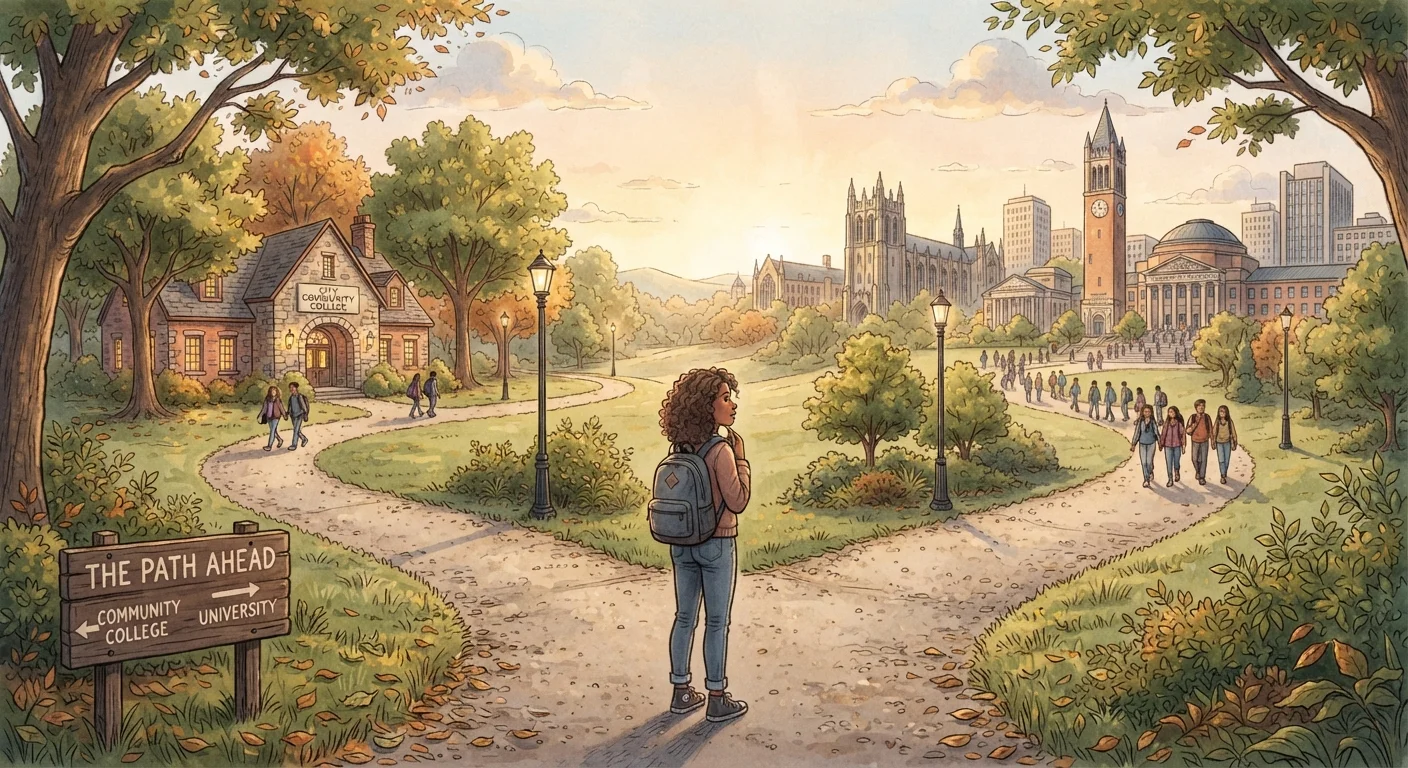
The Real Cost Difference - and What It Means Over Time
Cost is often the first factor students weigh, and the gap between the two paths is substantial. According to the College Board's annual Trends in College Pricing report, average annual tuition and fees at public two-year colleges are considerably lower than at public four-year institutions - and dramatically lower than private four-year universities. For students who complete two years at a community college before transferring, the overall cost of a bachelor's degree can be meaningfully reduced.
However, the financial picture is more nuanced than tuition alone. Room and board, transportation, and the opportunity cost of time in school all factor in. Students should also investigate whether transfer credits will be fully accepted at their target university - lost credits extend time to graduation and add cost. Many states have formal articulation agreements that protect transfer students' credits, so researching those agreements early is essential.
~$3,900
Average annual public community college tuition
According to the College Board's Trends in College Pricing report, public two-year college tuition is a fraction of four-year costs.
~$11,260
Average in-state tuition at public four-year universities
The College Board reports this figure represents tuition and fees only, before room, board, and other expenses.
49%
Share of undergraduates enrolled in two-year colleges
The American Association of Community Colleges estimates that nearly half of all U.S. undergraduates attend community colleges.
It is also worth noting that financial aid, scholarships, and grants are available at both types of institutions. Community college students sometimes assume they are ineligible for substantial aid - that is not always accurate. Completing the FAFSA regardless of institution type is a critical first step.
Academic Experience and Opportunity: Where the Paths Diverge
Four-year universities generally offer a wider range of academic departments, research programs, and extracurricular activities. For students interested in undergraduate research, study abroad, or dual degrees, these opportunities are often more accessible at larger institutions. If those experiences matter to your goals, see our guide to overlooked undergraduate opportunities for a fuller picture.
Community colleges, by contrast, tend to have smaller class sizes and more accessible faculty - advantages that can support students who benefit from closer attention or are returning to academic study after time away. The academic rigor of transfer-track programs at accredited community colleges is often comparable to freshman and sophomore coursework at four-year schools.
| Criterion | Community College | Four-Year University |
|---|---|---|
| Average Annual Tuition (public) | ~$3,900 (2-year) | ~$11,260 (4-year, in-state) |
| Time to Bachelor's Degree | 2+2 years (with transfer) | 4 years (typical) |
| Class Size | Generally smaller | Varies; often larger |
| Campus Life & Extracurriculars | Limited | Extensive |
| Research Opportunities | Rare at 2-year level | Commonly available |
| Schedule Flexibility | High (evening, hybrid options) | Moderate |
| Transfer Credit Risk | Possible loss without articulation | Not applicable |
One important consideration: if you are undecided about your major, community college offers a lower-risk environment to explore. Research on major selection suggests that many students change direction at least once. Our related article on declaring a major explains why that timeline is more flexible than most students assume.
Career Outcomes and Employer Perceptions
The relationship between the institution you attended and your career outcomes is real but often overstated. Employer surveys, including those conducted by organizations like the National Association of Colleges and Employers (NACE), consistently show that for many roles, employers prioritize relevant experience, skills, and internships over institutional prestige. Internship experience, in particular, has a measurable influence on hiring and early salary.
That said, certain fields and graduate programs do weigh institutional background more heavily. Highly competitive graduate schools, elite law and medical programs, and some research-intensive industries may give an edge to applicants from well-known four-year universities. If your career goals include a specific graduate pathway, investigate that program's typical applicant profile before assuming either route is equivalent.
For students considering alternatives beyond the traditional four-year track, it is also worth comparing how vocational and degree pathways differ - our vocational training vs. traditional degree comparison lays out those distinctions clearly.
Online Learning as a Third Option
Some students find that neither a traditional community college nor a four-year university fits their circumstances. Online degree programs - offered by both types of institutions - have expanded significantly. For a balanced look at what that pathway genuinely offers and where it falls short, see our overview of online learning trade-offs. Online options can complement either path, but they come with their own set of considerations around accreditation, engagement, and credential recognition.