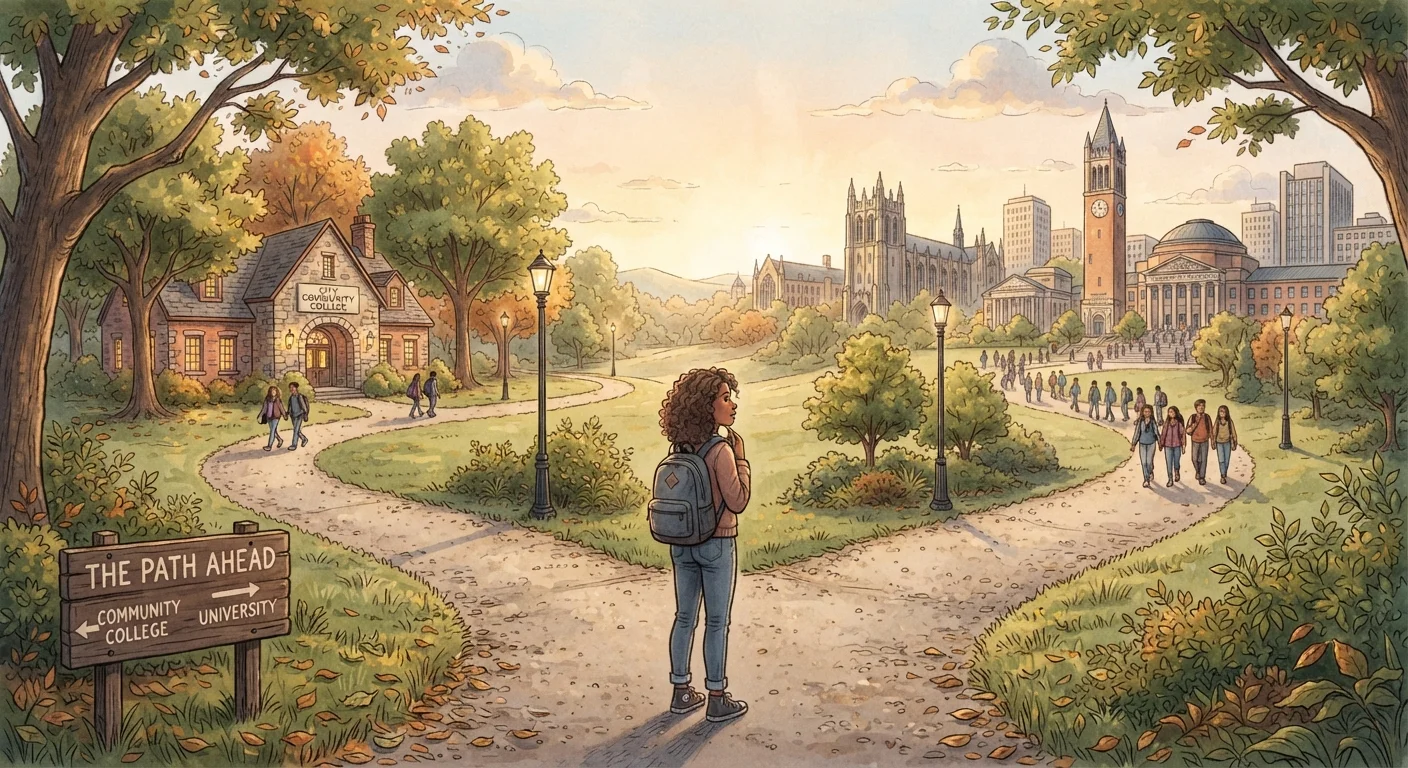

The Pressure to Decide - and Where It Actually Comes From
Many incoming students arrive on campus believing they must declare a major immediately - or risk falling behind. This pressure often comes from well-meaning family members, college prep culture, or application processes that ask students to indicate an intended area of study. But indicating interest on an application is meaningfully different from making a binding academic commitment.
In reality, most four-year institutions in the United States formally require students to declare a major by the end of their sophomore year - typically around 60 credit hours. Before that deadline, students can explore coursework freely, often fulfilling general education requirements that count toward any degree. Understanding where this pressure originates helps students separate institutional policy from social expectation.
If you're also weighing the type of institution that's right for you, exploring the trade-offs between community college and four-year universities can inform how timing decisions play out differently depending on your path.
Common Myths About Declaring a Major
Several persistent misconceptions shape how students approach this decision. The myth-and-fact pairs below address the most common ones, grounded in how academic systems and career outcomes actually work.
Myth
You need to declare a major before classes start, or you'll fall behind your peers.
Fact
Most four-year colleges don't require a formal major declaration until the end of sophomore year, around 60 credit hours.
Application forms often ask for an "intended major," which students can - and frequently do - change before or after enrollment without academic consequence. General education requirements give undeclared students meaningful, credit-bearing work to complete while they explore. Arriving undecided does not mean arriving unprepared.
Myth
Changing your major means wasting time and money.
Fact
With good advising, many major changes can be made without significantly extending time to graduation.
Because most degree programs share foundational general education requirements, credits earned early in college typically count toward any major. The impact of a change depends heavily on when it happens and how well a student plans the transition with an adviser. A switch made in the first or second year is usually far less disruptive than one made in the final semester of junior year.
Myth
Undeclared students are unfocused or unprepared - and admissions officers view them negatively.
Fact
Many selective institutions actively welcome and admit undeclared applicants; being undecided is not a mark against intellectual seriousness.
Admissions processes evaluate curiosity, academic potential, and character - not certainty about a career path. In fact, applicants who demonstrate genuine intellectual range and honest self-reflection about their interests can come across as more thoughtful than those who state a declared path with no supporting rationale. Admissions offices at most schools are well accustomed to undeclared applicants and have advising structures designed for them.
Myth
Your major determines your career, so getting it right immediately is critical.
Fact
Research consistently shows that most professionals do not work in fields that directly match their undergraduate major.
Surveys of working adults regularly find that the majority are employed in roles that are not a direct match for their college major. Skills - analytical thinking, writing, quantitative reasoning, interpersonal communication - transfer across industries. A major signals capability and commitment to learning within a discipline, but it rarely closes off career pathways in unrelated fields. Graduate school, professional certifications, and work experience all reshape career trajectories well after a diploma is earned.
Myth
If you're still undecided by sophomore year, you've already made a costly mistake.
Fact
Second-year exploration is normal and still provides enough runway to complete most majors within a standard four-year timeline.
Most major programs require roughly 30-45 credit hours of major-specific coursework. With 60 or more general education credits typically completed by the end of sophomore year, declaring a major at that point still leaves ample time to fulfill requirements. Advisers at most institutions flag students who have not declared by a set milestone and offer structured support - it's a managed transition, not a crisis point.
What the Data Suggests About Changing Majors
Switching majors is far more normal than campus culture often implies. Research from the National Center for Education Statistics has found that a substantial proportion of bachelor's degree students change their major at least once during their undergraduate years, and many change more than once. Contrary to the fear that switching adds years to a degree, timely advising and strategic course selection frequently allow students to change direction without significant delays.
~30%
Students who change major within 3 years
According to the National Center for Education Statistics, roughly 30% of undergraduates who began as degree-seeking students changed their major within three years of initial enrollment.
2nd year
Typical deadline to declare at most 4-year colleges
A review of institutional policies at U.S. four-year colleges generally places the formal declaration deadline around the end of the sophomore year, with flexibility built in for exploratory students.
The key variable is not whether a student changes a major, but how early they engage with academic advising when they begin to have doubts. Students who address uncertainty proactively - rather than waiting until junior year - tend to navigate transitions with the least disruption. Many campuses also offer "exploratory" or "undecided" designations specifically designed to support students during this process.
Making a Deliberate, Well-Timed Decision
Rather than rushing a declaration, students benefit from using the first year or two to test assumptions. Taking an introductory course in a field of interest before committing to it as a major is one of the most reliable ways to assess genuine fit - both intellectual and practical. Shadowing professionals, participating in campus clubs related to a field, and speaking with upperclassmen in a department all provide real-world signal that a course catalog alone cannot.
Advising Is the Most Underused Resource
Academic advisers can model out exactly how a potential major change affects your graduation timeline, required coursework, and financial aid eligibility. Many students avoid advising appointments out of anxiety about judgment - but advisers work with undecided and switching students routinely. Schedule a meeting early, even if you have no urgent questions. The earlier the conversation, the more options remain open.
It's also worth remembering that a major does not map one-to-one onto a career. Employers hiring recent graduates frequently cite communication, critical thinking, and collaboration as skills they prioritize - qualities developed across many disciplines. Students who feel uncertain about a major sometimes benefit from asking a different question: not "What do I want to do for a living?" but "What kinds of problems do I enjoy working on?"
For students who want to deepen their academic profile beyond a single major, opportunities like undergraduate research, study abroad, and dual degrees can add dimension regardless of when a major is declared. And for those who later find their undergraduate choice doesn't align with their evolving goals, adult career-change strategies offer a practical framework for navigating that shift.